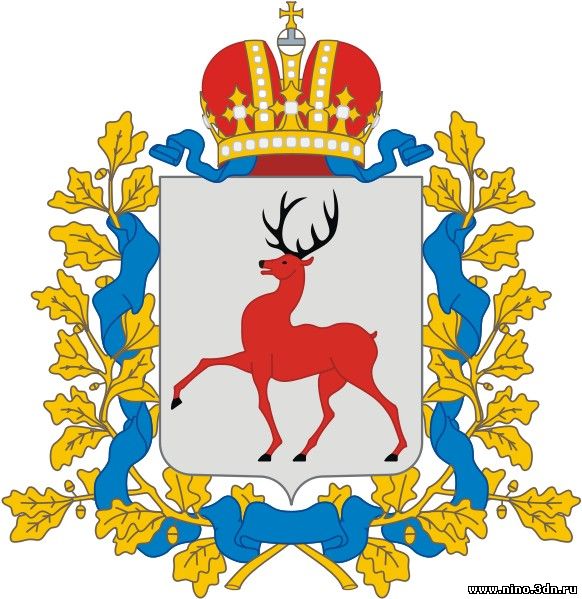
Nizhny Novgorod Region (NR) is the administrative name of a historic region in the north-east of the Central European part of Russia, centered at the confluence of the Volga River and Oka rivers. It is a federal subject of the Russian Federation.
The administrative center of the Region lies at 56° north latitude and 44° east longitude (see Nizhny Novgorod Meridian). The Region covers an area of 80,500 sq. km and has a population of 3.72 million. It comprises 48 districts, 25 towns, 70 urban-type settlements, and 4,630 villages and rural localities.
The Region's capital — the city of Nizhny Novgorod, situated at the confluence of the Volga River and Oka rivers (see also Cape Strelka) — covers an area of approximately 350 sq. km and has a population of 1.3 million by official count and some 200,000 more by unofficial estimates. By actual population, Nizhny Novgorod is the third largest city in Russia after Moscow and Saint Petersburg, and is one of 100 cities in the world recognized by UNESCO as being of global cultural significance.
Nature of the Phenomenon
In the Middle Ages, our land was called Ponizoye — "the Lower Country." And so it was: no matter which direction you sailed from — whether down the Volga from Yaroslavl, founded by Yaroslav the Wise, or along the Oka from Moscow and the Ryazan lands, or down the Klyazma from the Russian capital of Vladimir — the current of every river in eastern Rus would carry you down here, to the confluence of the Oka and the Volga.
History of Settlement
The history of the Nizhny Novgorod land reaches back into the remote past. Archaeological excavations have shown that in the 3rd–2nd millennia BC the territory of our region was inhabited by tribes of the Balakhninsky Neolithic culture, which takes its name from the most representative site excavated near the present-day city of Balakhna. The Balakhna people lived in small settlements of 25–30 adults, arranged in compact clusters. In addition to the vicinity of Balakhna (Bolshoye Kozino, Maloye Kozino), archaeologists have identified such clusters near the cities of Pavlovo, Dzerzhinsk (Gavrilovka, Zhelnino, Volodarsk), Gorodets (Serkovskaya, Sokolskaya), and Nizhny Novgorod (in Sormovo District, Molitovka, and on the Mokhovye Hills). Balakhna-culture sites have also been found on the Linda River (Lindovskaya, Ostreyevskaya), in the Vetluga Region, in the valley of the Tyosha River, and elsewhere.
The Balakhna people were hunters and fishermen. Judging by the tools found, they were able to grind, polish, bore, and saw stone, and to make clay vessels. They also knew how to weave from plant fibers. In the second half of the 2nd millennium BC they learned to smelt metal, became acquainted with hoe farming, and engaged in animal husbandry.
A few kilometers to the south-east of Seyma station, archaeologists discovered the Seyma burial ground, dating to the 15th–12th centuries BC. The finds included pottery fragments, cast bronze chisel-shaped socketed axes, large spearheads, knives, and daggers. Alongside the bronze implements were flint tools: arrowheads, saw blades, and fragments of drilled implements. There were also unexpected finds — objects made of nephrite and an amber bead, even though neither nephrite nor amber deposits exist within the Region. These discoveries attest to the wide-ranging connections of ancient peoples, stretching from the northern seas to Central Asia and Lake Baikal. The most valuable items are now part of the collection of the State Historical Museum in Moscow.
The daily life and activities of people from the Bronze and Iron Ages are illuminated by excavations of other sites and burial grounds: the Churkinsky burial ground (near Balakhna), the Sergachsky burial ground, uncovered in the Kozhina sloboda (1st–3rd centuries AD), the Gaginsky and Khirinsky burial grounds near the city of Arzamas (mid-1st millennium AD), and the Bogorodskoye, Rusinikhinskoe, Odoyevskoye, and Chertovoye hillforts on the Vetluga.
In the 1st millennium AD, Mordva tribes lived along the Tyosha River, Pyana River, Alatyr, Kudma River, and Oka rivers. The Vetluga Region was home to the Mari. A small territory along the Oka up to its confluence with the Volga was occupied by the Muroma.
In the 12th century, the first Slavic settlements appeared at the mouth of the Oka. Farmers from the south-west, from the principalities of Kievan Rus during its fragmentation, and from the north-west, from the Vladimir-Suzdal land, filtered into the free, sparsely populated territories and settled in family groups along the banks of the Oka and the Volga. The Slavs settled among the indigenous inhabitants, colonizing first and foremost the lands of what are today the Gorodetsky District, Balakhninsky District, and Borsky District Districts.
Culture and the Arts
Nizhny Novgorod Region is rich in institutions of cultural and historical value. Every day, many people visit these establishments to relax and "touch something beautiful."
- 15 theaters (the State Academic Opera and Ballet Theatre named after A. S. Pushkin, the Comedy Theatre, the Young Spectators' Theatre, the Academic Drama Theatre named after M. Gorky, the Puppet Theatre, the children's municipal theatre "Vera," and others);
- 8 state museums and 61 municipal museums (a history and architecture museum-reserve, the Museum of Gorky's Childhood, the A. S. Pushkin Museum-Reserve in Bolshoye Boldino, an art museum, the literary-memorial museum of Nikolai Dobrolyubov, the memorial museum of V. P. Chkalov, an open-air museum of Russian wooden architecture, a museum of the history of traditional folk crafts, the Russian Museum of Photography, the Museum of the Everyday Life of the Peoples of the Nizhny Novgorod Volga Region, an exhibition complex, and others);
- a philharmonic society (whose performing roster includes an academic symphony orchestra, instrumental soloists, singers, masters of spoken word, art critics and lecturers, and a percussion ensemble);
- a conservatory;
- 4 orchestras;
- a professional choral ensemble;
- 1,141 libraries, including the Regional Library named after V. I. Lenin;
- the "Rekord" film center;
- 201 cinema installations;
- 1,146 club institutions in the cities and districts of the Region, encompassing 8,788 club groups;
- 7 secondary specialized vocational educational institutions;
- children's music schools, art schools, and arts schools;
- the state enterprise of Nizhny Novgorod Region "Oblkinovideoobedinenie";
- the Regional scientific and methodological center for folk arts;
- the Regional methodological office for educational institutions of culture and the arts;
- the State Educational Institution innovation and research resource "Centre 'Kultura'" and others;
- 9 Parks of Culture and Leisure.
Territory of Nizhny Novgorod Region with Regulated Access for Foreign Nationals
Territory within the boundaries of Pervomaysky — Purekh — Chistoye — Krasnaya Gorka — Volodarsk — Dzerzhinsk — Pervomaysky (excluding the named localities).
Transit passage is permitted by rail and by road along the Gorokhovets — Nizhny Novgorod highway, with stops in the towns of Volodarsk and Dzerzhinsk.
LIST OF TERRITORIES OF THE RUSSIAN FEDERATION WITH REGULATED ACCESS FOR FOREIGN NATIONALS (as amended by Resolutions of the Government of the Russian Federation of 17.11.94 No. 1273, of 27.11.95 No. 1171, of 27.12.97 No. 1641, of 30.10.2001 No. 755, of 29.04.2002 No. 277, of 09.07.2002 No. 513, of 11.06.2004 No. 276, of 21.03.2006 No. 155, of 13.08.2006 No. 484, of 15.11.2006 No. 686, of 01.12.2008 No. 898, of 23.12.2009 No. 1076)
Executive Authority
- Valery Shantsev — Governor, Chairman of the Government of Nizhny Novgorod Region
- Vladimir Alexandrovich Ivanov — Vice-Governor, Deputy Chairman of the Government of Nizhny Novgorod Region
- Gennady Alexandrovich Suvorov — Deputy Governor, Deputy Chairman of the Government of Nizhny Novgorod Region
Population Characteristics
Number of People with Higher Education
Number of people with higher education in Nizhny Novgorod Region per 1,000 persons (age-adjusted), according to the most recent census:
- among the urban population — 170
- among the rural population — 62
Postgraduate education ("associate professors and candidates of sciences"):
- among the urban population — 3
- among the rural population — 1
Incomplete higher education (mostly various kinds of students):
- among the urban population — 31
- among the rural population — 10
96 people out of every 1,000 have only a primary education, and nothing beyond it.
11 adults out of every thousand Nizhny Novgorod residents have no primary education at all.
The remaining residents have only a secondary education.
So, about 20 percent of the people of Nizhny Novgorod have been corrupted by higher education to varying degrees. That's all!
That is, you tend to move in fairly narrow circles where everyone around you seems to have a higher education, and all your relatives have one too. Yet higher education is by no means something everyone has. Educated people are comparatively few.
Incidentally, Samara has more people per thousand with higher education than we do — 167. And Saratov has 157.
Districts of the Region
Interesting Facts
- In Soviet times, the entire region had no more than 25,000 motor vehicles. Today, Vyksa, with a population of 86,000, has that same number — 25,000 cars — while Nizhny Novgorod has more than half a million registered [1] (archive).
- In 37% of settlements in Nizhny Novgorod Region, the population ranges from 0 to 10 people. [2] (archive)