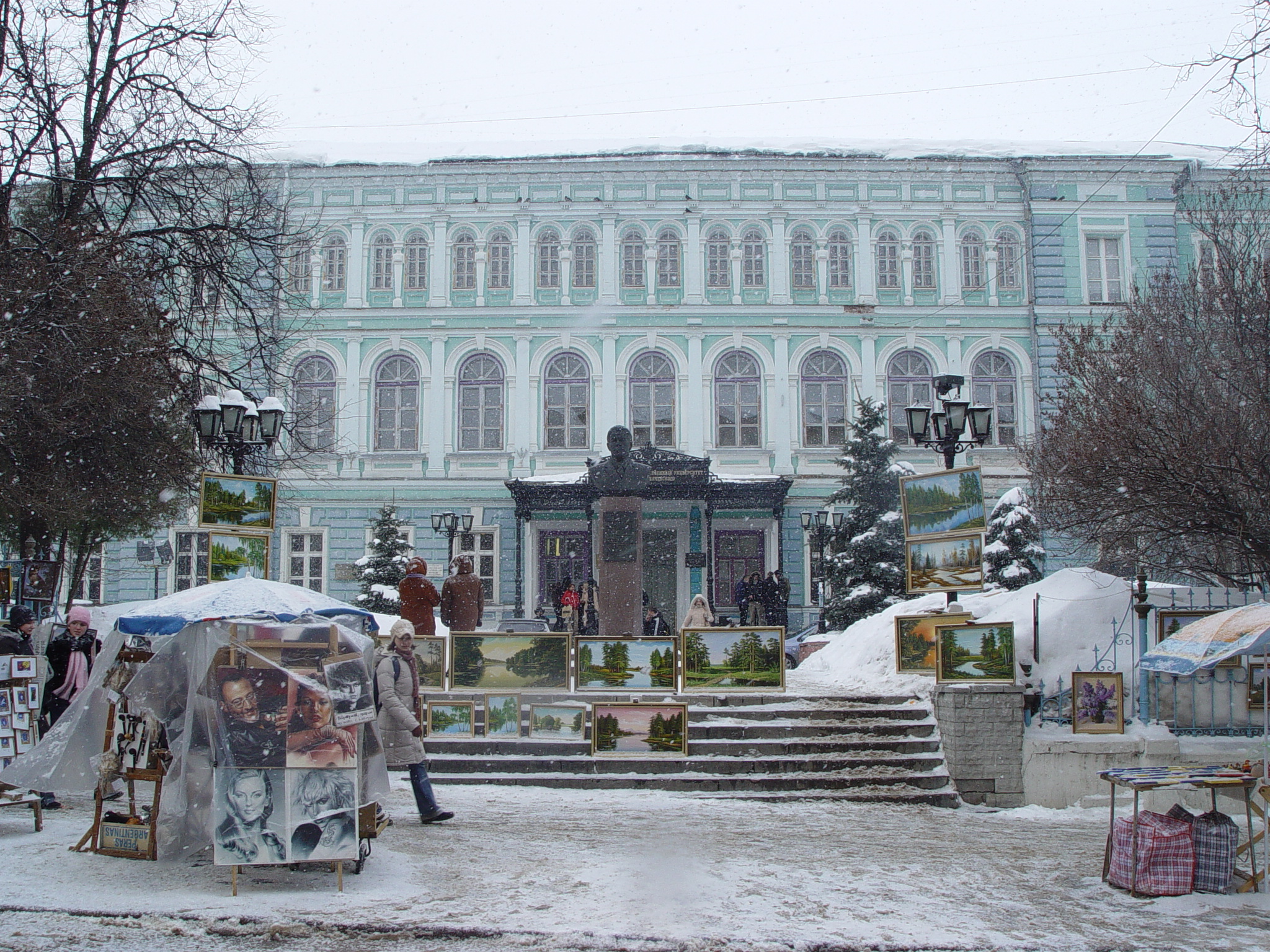
Lobachevsky State University of Nizhni Novgorod — National Research University (formerly NNGU, GGU — Gorky State University) — the leading institution of higher education in the Nizhny Novgorod Region, and the oldest institution of College in the region.
History
Lobachevsky State University of Nizhni Novgorod (NNGU) was founded on January 17, 1916, as one of three People's Universities in Russia, becoming the first institution of higher education in Nizhny Novgorod. In 1918, following a merger with the Polytechnic Institute evacuated from Warsaw and with the Higher Agricultural Courses, the university was granted state status (making it the first Soviet university).
In 1930, six narrowly specialized institutes were established on the basis of several faculties of Nizhny Novgorod University: mechanical engineering, chemical, pedagogical, agricultural, construction, and medical. By 1932, NNGU comprised the following departments: physics, mechanics, zoology, botany, chemistry, and mathematics.
By the second half of the 20th century, UNN had grown into a major scientific and educational center, home to world-renowned research schools in the theory of oscillations (Academician A. A. Andronov), crystallography (Academician N. V. Belov), radiophysics (Academician A. V. Gaponov-Grekhov), chemistry of organometallic compounds (Academician G. A. Razuvayev), chemistry of high-purity substances (Academician G. G. Devyatykh), function theory (Professor I. R. Braitsev), theory of dynamical systems (Professor Yu. I. Neymark), population genetics (Professor S. S. Chetverikov), and others. The university's laboratories served as the initial foundation for establishing Nizhny Novgorod institutes of the Russian Academy of Sciences. Significant achievements were also made in the humanities, associated with the names of Corresponding Member S. I. Arkhangelsky, Professors N. P. Sokolov, B. N. Golovin, and others.
From its founding, Lobachevsky University has been a distinctly innovative institution, delivering education grounded in research and closely tied to national objectives. In 1945, UNN established the first radiophysics faculty in the USSR; in 1963, it established the Faculty of Computational Mathematics and Cybernetics — likewise the first in the country — providing a crucial impetus for the development of the radio-electronics industry and information technology. The university's active engagement in solving pressing complex scientific and technical problems led to the formation within UNN of major research institutes: the Physical-Technical Institute (1932), the Institute of Chemistry (1944), the Radiophysical Institute (1956), the Institute of Applied Mathematics and Cybernetics (1964), the Institute of Mechanics (1974), and the Institute of Molecular Biology and Regional Ecology (2002). The university also established the country's first Faculty of Management and Entrepreneurship (awarded the Nizhny Novgorod Prize for 1997) and the first Department of Technology Transfer and Entrepreneurship in Science and Technology, which trains managers for small science-intensive firms. UNN is the only higher education institution in the Volga Federal District offering programs in taxation, customs affairs, international relations, and information technology. UNN students regularly win prizes at All-Russian Olympiads in physics, mathematics, and programming. University student teams consistently advance to the finals of the World Programming Championships.
In official rankings, the university consistently places among the top ten universities in Russia and ranks first among universities in the Volga Federal District. UNN enrolls approximately 40,000 students, including around 1,000 postgraduate and doctoral candidates. Instruction is offered across 46 specializations, 15 master's degree programs (56 tracks), 23 bachelor's degree programs, and accelerated study programs. Postgraduate training is available in 52 academic specializations, and doctoral training in 24. UNN operates 20 dissertation defense councils, including 17 at the doctoral level.
Academic and research work at the university is carried out by 300 doctors of science, 900 candidates of science, 17 full members and corresponding members of the Russian Academy of Sciences, 23 Honored Scientists of the Russian Federation, 33 laureates of State Prizes, Government Prizes, and Presidential Prizes of the Russian Federation, 37 laureates of the Nizhny Novgorod Prize, 71 Honorary Workers of Higher Professional Education of the Russian Federation, and 18 Honored Workers of Higher Education.
Authority
- President of UNN — Strongin, Doctor of Physical and Mathematical Sciences, Professor, Head of the Department of Mathematical Software for Computers. Honored Scientist of the Russian Federation, laureate of the Presidential Prize of Russia in Education and the Nizhny Novgorod Prize in Higher Education. Chairs the councils of rectors of higher educational institutions of the Volga Federal District and Nizhny Novgorod Region. Honorary Doctor of London Metropolitan University.
- Rector of UNN — Chuprunov, Doctor of Physical and Mathematical Sciences, Professor.
Structure and Divisions
The university comprises 19 faculties: Biology, Chemistry, History, Radiophysics, Physics, Mechanics and Mathematics, Economics, Computational Mathematics and Cybernetics, Philology, the Vysshaya Shkola of General and Applied Physics, Law, Management and Entrepreneurship, Finance, Social Sciences, Military Training, Physical Education and Sports, International Relations, Preparatory, and International Students; 132 departments; 5 research institutes (Physics and Technology, Chemistry, Mechanics, Applied Mathematics and Cybernetics, Molecular Biology and Regional Ecology); 5 branch campuses and 6 representative offices in the Nizhny Novgorod Region; a Fundamental Library with a collection of over 2 million items; an Innovation and Technology Center; a publishing house and print shop; a museum complex — including a zoological museum (ranked among the top 5 in Russia), an archaeological museum, an ethnographic museum, a university history museum (with an art gallery), and a memorial museum of the Nizhny Novgorod Radio Laboratory.
Interesting Facts
- From the UNN charter: "The University is entitled to engage in commercial activities...", "non-governmental (private) security activities", "the collection of scrap and waste of precious metals", "activities related to the trafficking of narcotic drugs and psychotropic substances..." and much more of interest.
Contacts
Addresses
- 603950, Nizhny Novgorod, Gagarin Avenue, 23. University campus.
- Bolshaya Pokrovskaya St., 60. Faculty of Economics. Center for Economics Training. International Center for Research on State Regulation of the Economy.
- Bolshaya Pokrovskaya St., 37. Faculties: Philology, Finance, Social Sciences. Educational and Methodological Center for Training, Retraining, and Certification of Auditors. Print shop.
- Ashkhabadskaya St., 4. Faculty of Law. Council of Europe Regional Center for Human Rights Information and Documentation. Legal Clinic.
- Ulyanova Street., 2. Faculty of History. Institute for Strategic Studies. Museums: Archaeological, Ethnographic. Center for Contemporary Political Technologies.
- Ulyanova Street., 46. Faculty of the Vysshaya Shkola of General and Applied Physics.
- 60 let Oktyabrya Boulevard, 5 (School No. 187, Sovetsky District, Nizhny Novgorod). Faculty of Management and Entrepreneurship.
- Lenin Avenue, 95, office 93 (GAZ Group Corporate University building). Avtozavodsky branch of the Faculty of Management and Entrepreneurship.
- Pavel Mochalov St., 9, office 217 (third building of the Nizhny Novgorod Medical Basic College). Sormovo branch of the Faculty of Management and Entrepreneurship.
- Universitetsky Lane, 7. Computing Center, Internet Center.
- Ulyanova St., 10. Research Institute of Applied Mathematics and Cybernetics.
- Bolshaya Pecherskaya St., 25/14. Scientific Research Radiophysics Institute.
- Verkhne-Volzhskaya Embankment, 5. Memorial Museum of the Nizhny Novgorod Radio Laboratory.
- Dubenki settlement. Botanical Garden.
- Staraya Pustyn village. Biological Station.
- Gorky Sea. "Zarya" Student Sports and Recreation Camp.
Phone Numbers
Administration and Rectorate
- Rector's office: 462-30-03
- President's office: 462-30-01
- First Vice-Rector, Vice-Rector for Academic Affairs: 462-30-02
- Vice-Rector for Research: 462-30-04
- Vice-Rector for Administrative and Economic Affairs: 462-30-05
- Vice-Rector for Security: 462-30-06
- Vice-Rector for Informatization and Pre-University Preparation: 462-30-09
- Vice-Rector for International Affairs and Educational Innovation: 462-30-08
- Vice-Rector for University Branch Management: 462-30-07
Research Units
- Research Department: 462-31-25
- Research Institute of Physics and Technology: 465-71-50 (director)
- Research Institute of Chemistry: 465-80-42 (director)
- Research Institute of Applied Mathematics and Cybernetics: 436-23-61 (director)
- Research Institute of Mechanics: 465-66-11 (director)
- Research Institute of Molecular Biology and Regional Ecology: 419-90-64 (director)
- Innovation and Technology Center: 434-59-01
- Institute of Postgraduate and Doctoral Studies: 462-36-45 (pgrad@unn.ru) (director)
Admissions Office
- Admissions Office Secretariat: 462-30-45
Services
- Registry Office: tel. 462-30-90, fax. 462-30-85
- Finance, Accounting and Reporting Department: 462-30-10
- Human Resources Department: 462-30-51
- Public Relations Office: avralev@unn.ru
- Student Trade Union Committee: 462-37-71
Rector's office: rector@unn.ru. Press secretary: pr@unn.ru