
|
Nizhny Novgorod, erected on the site of a Mordva fortress taken by storm, became the frontier city of Rus in 1220 Gumilev L.N., historian
|

|
|
|
The great prince Yuri founded a town against the Bulgars at the mouth of the Oka River, naming it Novgorod Nizhny, for there had previously been a Bulgarian town Tatishchev V.N., historian
|
|
Several theories exist regarding the founding of Nizhny Novgorod, each linking this act to one of the religious communities of the Volga Region — Jewish, Islamic, and Christian. The names change accordingly: "Abramov Gorodok," "Ibrahim Balyk," and "New Town of the Lower Land." The chronologically latest, Christian version of the founding of Nizhny emphasizes the legitimacy of the transfer of power from the local Mordva aristocracy to the Vladimir-Suzdal prince — presumably in order to distinguish itself from the alternative versions that already existed at the time.
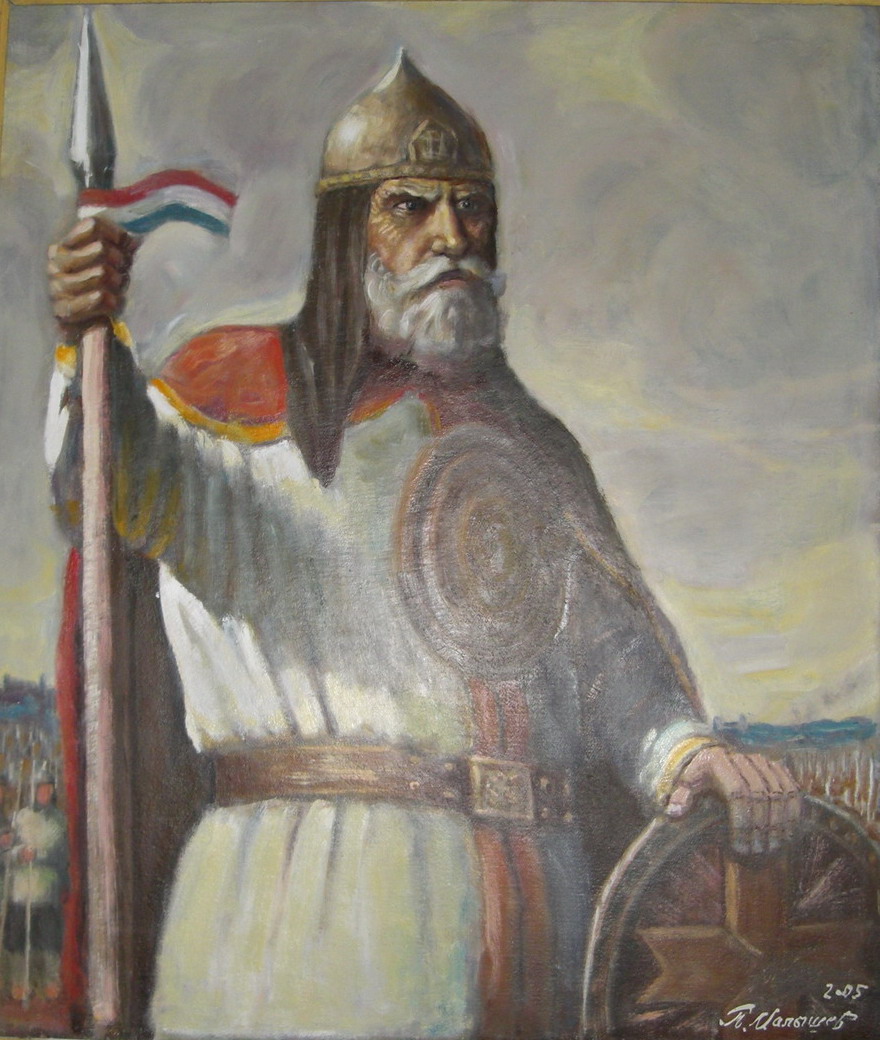
The Mordva name of the Forerunner of Nizhny Novgorod — "Obran Osh" or "Obranov Gorodok" — traces back to the figure of Prince Purgaz, a symbol of Erzya statehood and national unity.
A 19th-century legend
The legend of the founding of the city of N. Novgorod and the Russian conquest of the Mordva:
"A Russian prince, Murza, was traveling along the Volga River; at that moment on the hill the Mordva, in their white cloaks, were praying to God; Murza asked his warriors: 'What is that birch grove swaying and rocking, bowing eastward to Mother Earth?'"
Those sent to investigate reported that it was not a birch grove swaying and rocking, but the Mordva praying to their god; in their tubs stood sweet ale, from poles hung fried eggs, in cauldrons they were boiling beef…
The Mordva elders, learning of the arrival of Russian prince Murza, sent him beef and ale with some young men; the young men ate the beef and drank the ale along the way, and brought the Russian prince only earth and water.
Prince Murza rejoiced at this gift and took it as a sign of submission from the Mordva tribe, and sailed on along the Volga: wherever he cast a handful of the earth brought to him by the unwitting young Mordva men onto the bank — there a town would arise; wherever he scattered a pinch — there a village would be… And so the Mordva land was conquered by the Russians.
(Khramtsevsky. A Brief Historical Sketch and Description of N. Novgorod. 1857. Vol. 1.).