
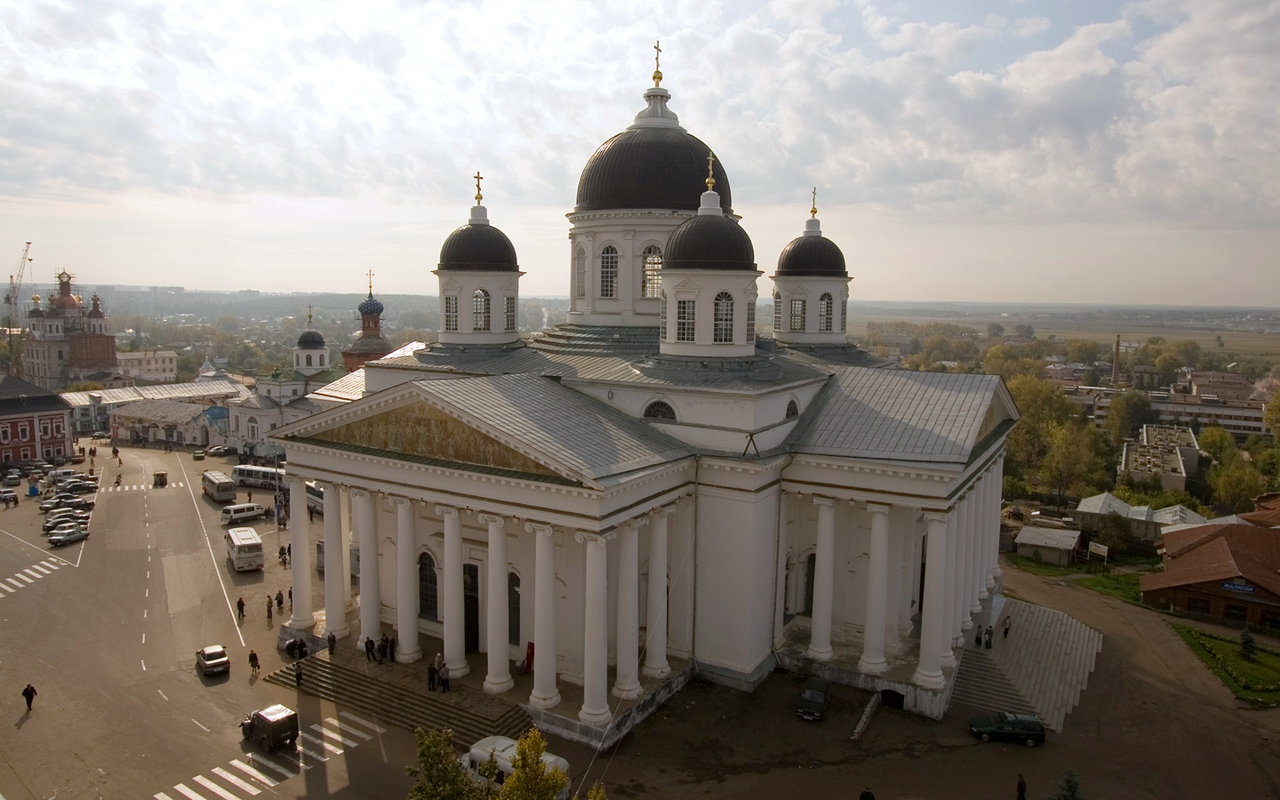
Arzamas (Erzymaz, Erzymas) — a well-kept administrative center of Arzamassky District, nestled amid gardens, in Nizhny Novgorod Region. An ancient Russian town. It was formerly the ancient center of Erzya statehood and was called Erzymas in honor of the Erzya who inhabited it. The city stands on the high right bank of the Tyosha River (a tributary of the Oka). Its position at the center of the right-bank part of the Region, 112 km from Nizhny Novgorod, 410 km from Moscow, at the intersection of railway mainlines and at the hub of several highways, gives Arzamas a transport and geographical position favorable for industrial development.
In relation to the surrounding districts, it serves as a kind of "capital" of the right-bank Nizhny Novgorod area.
Historical overview
In 1552, Tsar Ivan the Terrible ordered a fortress-town to be founded here as he marched on his third campaign against Kazan. Arzamas was "commanded to be in the sovereign's service." The official year of foundation is considered to be 1578.
The Arzamas fortress played an important role in the defense of the southeastern borders of the Russian state. This historical distinction was reflected in the city's coat of arms — a shield design (on a gold field, two chevrons: the upper one red, the lower one green) — confirmed on 16 August 1781 by a decree of Her Imperial Majesty, Autocrat of All Russia, Catherine II, dated 26 August 1781.
In 1719, Arzamas was the principal city of a province within Nizhny Novgorod Governorate. The city was renowned for its trade, particularly in onions and its famous Arzamas geese — which earned the people of Arzamas the nicknames "onion sellers" and "goose traders" throughout Russia. Arzamas was also known for leather tanning and leather goods. The famous Arzamas yuft (Bulgarian leather) was exported to England, France, and Germany.
In the 18th century, up to a dozen of the most important trade routes passed through Arzamas — the Moscow, Nizhny Novgorod, Simbirsk, Saratov, Tambov routes, the "great road to Makariev," and others. During this period the city developed rapidly: its population grew, trade expanded, and industry flourished. This extraordinary heyday became known in the history of Arzamas as the "golden age," which lasted nearly a century, beginning in the mid-18th century.
Arzamas merchants, renowned for the variety and scale of their commercial operations, grew wealthy quickly. The results were soon reflected in the appearance of the city.
In 1781, simultaneously with other district towns, Arzamas received a planning project. However, the designers' insufficient familiarity with the local terrain led to substantial revisions to this first project, carried out between 1782 and 1784; the final plan for the lower part of the city was drawn up after the fire of 1823. Thus, the planning structure of Arzamas as it exists today took shape in the late 18th and first half of the 19th centuries.
Interesting facts
- According to one popular legend, the name Arzamas derives from the names of two brothers, Arzay and Masay, who greeted Ivan the Terrible with gifts and, in the presence of the tsar, were the first to convert to the Orthodox faith. In this respect, the Arzamas legend somewhat echoes Nizhny Novgorod Woodpecker, who 333 years earlier had greeted the Suzdal-Vladimir colonists in a similar fashion.
- By the total number of residential buildings at the end of the 18th century, the provincial capital Nizhny Novgorod was inferior to Arzamas (5 stone and 1,100 wooden buildings).
- According to another legend, the name Arzamas comes from the word "arsema," which in Erzya means "thought, idea, wish."