| City on the map |

|
The editorial office of the newspaper Sarov has learned from a competent source that the Central Electoral Commission of Russia, in connection with numerous complaints and a number of circumstances that have come to light which make it impossible to determine the results of the voters' expression of will with any certainty, has declared the local government elections held on March 14, 2010 in the city of Sarov invalid.
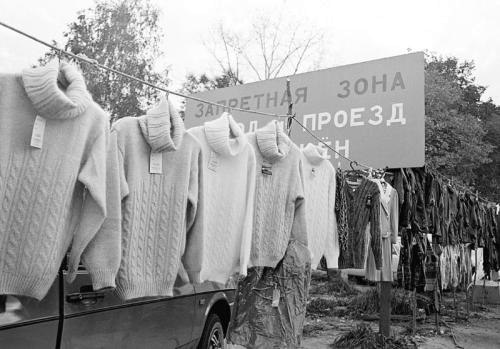
The head of the Central Electoral Commission, Vladimir Churov, whom our correspondent reached by telephone, declined to explain the decision, stating that the text of the document contains sufficiently complete information. The same source reported that, due to the inability of the Sarov Duma to exercise governmental authority over the territory of the closed administrative-territorial formation (ZATO) of Sarov, direct gubernatorial rule is being introduced in Sarov until the mandates of the newly elected city Duma deputies are recognized. The secretariat of Governor Shantsev officially declined to comment on the situation, but informally confirmed that the signing of documents on temporary gubernatorial rule over the territory of ZATO Sarov could take place as early as Thursday. Enormous changes await Sarov. Behind the reassuring declarations about the uniqueness of the Sarov ZATO, we failed to notice how wave after wave of Kremlin displeasure with the Sarov establishment — which had taken the bit between its teeth — kept building. The petty administrative pleasures of our officialdom are costing the country far too much. The two latest pieces of news are the ninth wave, ready to crash at any moment against Sarov's barbed-wire bastions — and those bastions will not hold. The year 2012 will be catastrophic for Sarov. According to our information, preliminary work on opening the city will begin as early as next year — for now only on paper, with assurances that it is being done just in case. But for those who understand, everything is already perfectly clear.Newspaper "Sarov", 1.04.2010
|

|
Musical group ARZAMAS-16 ("Arzamas-16")
|
|
ARZAMAS-16 lineup:
Formed: 1997 It is rather difficult to define the musical direction or style in which ARZAMAS-16 plays. Our compositions contain elements of industrial, alternative, punk, pop, and rock music. We simply cannot bring ourselves to label this thermonuclear mixture with a single word. And it is not our business to classify and define — let someone else do that. We will simply create and perform Music. And time and listeners will judge how well we have succeeded. Given the impossibility of pinpointing any single date as the birthday of our group, we propose the following key dates and periods in the lives of the people who would go on to form the creative collective of ARZAMAS-16. One of the first meetings took place in the autumn of 1997 between Sergey Golubev and Alex Repyov at a concert. The former was responsible for drums in the band Gothic Castle, while the latter played in the original lineup of the band Elysium. It was one of the largest concerts organized by Nizhny Novgorod bands. After the concert they met on the staircase of the Sputnik cinema lobby and exchanged words for the first time. Having showered each other with compliments, they parted ways — and two years later they were both playing in Elysium: Alex as a recruit on guitar, and Sergey as drummer. After playing several concerts together, they left Elysium almost simultaneously. The first, consumed by industrial longing, took the advice of Dmitry Kuznetsov (bassist of Elysium) and joined Mekhanicheskiy Apelsin (Mechanical Orange); the second continued playing in Gothic Castle for a while and, after its final breakup, went off to drum in a band called Street Beat. This was the spring of 2000. Some time later, having immersed himself in the affairs of MA, Alex meets Dmitry Tikhomirov — musician, internet activist, man of science, participant in the development and promotion of alternative music in Nizhny Novgorod, who was at the time actively involved in the life of MA in particular. As a result of many conversations between Dmitry and Alex about music, musical creativity, and the meaning of life, Dmitry picks up a bass guitar for the first time, while Alex leaves MA (practically in the middle of mixing the first MA album, which was never released) in order to create a more promising musical collective, which would later be named ARZAMAS-16. After some time spent creating and preparing trial musical material, the first rehearsal took place in late spring 2001 with the following lineup: Alex Repyov — vocals and keyboard sequences, Dmitry Tikhomirov — bass, Sergey Golubev — drums, and Sergey Karpov as a guest guitarist. Having confirmed that the group was capable of playing live, the collective set about finding a permanent guitarist and rehearsal space, while in the process expanding their technical capabilities and accumulating musical material. Only several months later did the group meet their future guitarist — Ruslan Ismailov, a promising and talented eighteen-year-old musician — and finally find their musical expression in music built on the symbiosis of Ruslan's guitar parts and the musical experiments of Alex and Dmitry. The collective then settled on its name — ARZAMAS-16 — and took part in a Russian tribute compilation dedicated to the legendary American collective of Martin Atkins, the band PIGFACE, which was subsequently released on INVISIBLE Rec. USA, the label belonging to M. Atkins. In the autumn of 2001 the group launched a trial balloon in the form of their first demo and the website www.a16.nm.ru (now arzamas-16.nnov.ru). From April 2002 onwards, ARZAMAS-16 found a permanent rehearsal space, enabling the collective to begin performing live. With the assistance of D. Kuznetsov, ARZAMAS-16 took part in a series of concerts by the band Elysium. The biography of ARZAMAS-16 does not end here, nor does the creative activity of the collective. |
|
How Sarov Was Never Renamed Pogrebinsk
"…Sarov is your brainchild, and our shared wish is to grow Sarov into the city of POGREBINSK"
Seventy years ago, on July 4, 1938, Yuly Moiseyevich Kaganovich, secretary of the Gorky Regional Committee of the VKP(b), delivered a report at the 6th Regional Party Conference. I will quote an excerpt from his report:
"In our region and in our regional party organization, over a number of years, a Right-Trotskyite, spy-terrorist-saboteur-wrecking underground operated, headed by Pramnek, Pakhomov, Stolyar, Pogrebinsky, Burov, Zashibayev, and others.
…In Diveevsky District a Right-Trotskyite wrecking organization was exposed, headed by the former district committee secretary Steshov and the former chairman of the district executive committee Dudarev. Their activity was directed primarily at provoking discontent and irritation among the masses. Moreover, they went so far as to engage in outright terror against local workers. They organized the murder of one collective farmer — Kudakov — who had attempted to expose them.
…The Diveevo organization was linked to Pogrebinsky and Roslyakov. Luchinin states in his testimony that he attended a meeting at Pogrebinsky's. Those present were: Luchinin, Sukhov, Steshov, and Kaganovich (Pervomaysky District).
I must say that this Kaganovich is merely a namesake. If on my wife's side of the family there are people who have been repressed, on the Kaganovich side no one has been arrested.
And so he states that they were all present there.
Who else was there? Shelukhin. Who is this Shelukhin? A criminal sentenced to death, whom Pogrebinsky elevated to the rank of militia sergeant.
It turns out that Pogrebinsky was engaged in training insurgent-terrorist cadres and organized from criminals a group (some 120 people) for combat work in case it should be needed. He also made use of criminals from the Sarov colony.
And so you see that the "district committee secretaries" Luchinin and the criminal Shelukhin are all acting together under Pogrebinsky's leadership.
All of this, comrades, vividly and convincingly demonstrates how all these counter-revolutionary, spy forces, criminals, and dregs of human society became intertwined into a single ball and represented, as Comrade Stalin says, a reckless, unprincipled gang of wreckers, saboteurs, and spies, acting on the instructions of foreign intelligence services."
As we can see, Pogrebinsky's name is mentioned in the report repeatedly. What is known about him?
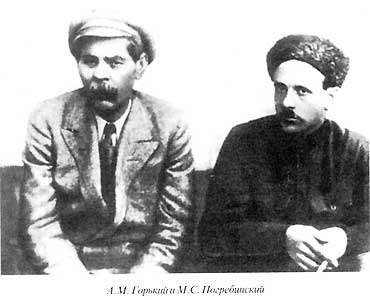
Pogrebinsky, Matvey (Motya) Samuilovich (1895–1937) — commissar of the 3rd rank, organizer of OGPU labor communes, author of the book The OGPU Labor Commune (1928). Accompanying Gorky on a trip to the Solovki islands, he selected young people from among the criminals there, who were then transferred to the Bolshevo OGPU commune (see Gorky's essay "Solovki," vol. 20, pp. 211–213). Before his transfer to Gorky in 1932, he had served as head of the NKVD Directorate of Bashkiria. While serving as head of the NKVD Directorate of Gorky Krai, on April 4, 1937, he took his own life in his office. Before his death he wrote a letter to Stalin. "He was too hasty!" said Stalin. "He would have told us much more…" Maxim Gorky, for his part, was fond of Pogrebinsky and jokingly called him "Motya the Militia Man."
Such is the way fate plays with a person: today a city is named after you, tomorrow you are trampled underfoot. True, the city of Pogrebinsk never appeared on any map. And yet there were those who wanted it to… In the Saransk archive there is preserved the following collective address to Pogrebinsky:
"Dear Matvey Samuilovich! It is a great pity that you cannot attend our celebration. However, we know that our growth, our achievements, and every victory we win in daily life and in production are the fruits of your fatherly care for us. Sarov is your brainchild, and our shared wish is to grow Sarov into the city of POGREBINSK.
In wishing to give Sarov your name, we know that in doing so we are taking upon ourselves many obligations. But we are on the right path, and difficulties do not frighten us. We will achieve what we set out to achieve, so that every Sarov resident will be worthy of your name. The right to say this is given to us by our today. Our today is the struggle for qualifications and knowledge. None of us is afraid anymore to raise our hand when a violator of discipline must be punished.
Sarov is your new victory in the cause of re-educating mankind, and we swear to you: we will build it into the city of POGREBINSK. Such is our shared wish.
With greetings: the general assembly of the Labor Colony. September 6, 1936, the settlement of Sarov." <..> (newspaper "Sarov", August 12, 2008, "Motya the Militia Man")