
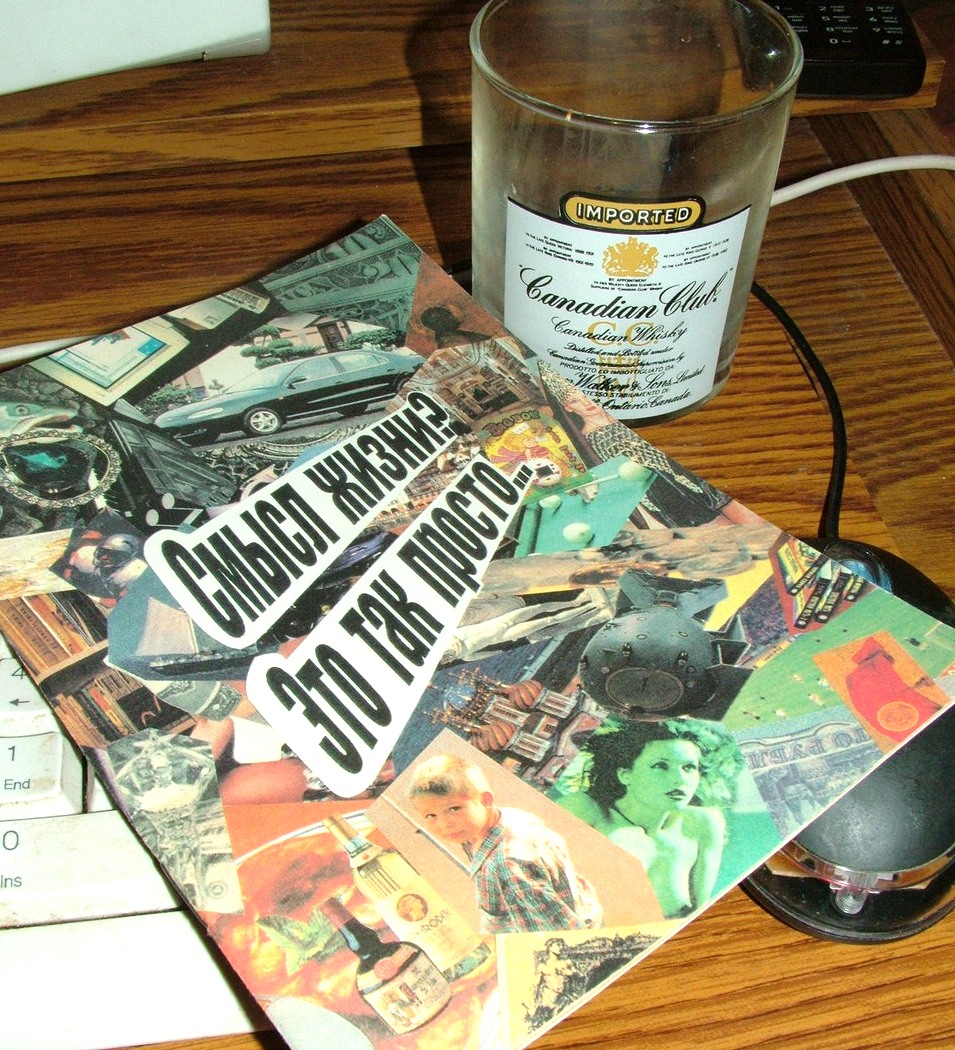
Intelligentism — a theory of positive existence in the information society. It explains why the intelligentsia will take over the world.
Developed by Nizhny Novgorod philosopher Golovinsky with the assistance of the Universum (Philosophy Club), the editorial collective of the Nizhny Novgorod Encyclopedia, Folk Heroes, the elite, and unknown graphomaniacs.
The Essence of the Phenomenon
Intelligentism is a mode of social organization in which the free exchange of information plays the most significant role in public life.
As information and the emotional states it generates become the primary commodity and object of simulation, Intelligentism (and not communism at all) will replace capitalism, as world civilization transforms from a post-industrial society into an information society.
Characteristics
- It has been established that, of all the population of Russia, Nizhny Novgorod residents are the most inclined toward Intelligentism.
- The key to Intelligentism is the Three-Glass Principle (demonstrated by Golovinsky).
Interesting Facts
Nizhny Novgorod Encyclopedia is published against the backdrop of Intelligentism's growing spread through our society, and is intended to manage that process.
If you notice too much Intelligentism in any article other than this one, call the editor on duty.
Criticism
- The worst enemy of any propaganda is intellectualism. (J. Goebbels)
The Future of Intelligentism
The Dawn of the Creative Class Dictatorship

|
An insignificant and, one might say, auxiliary stratum of creative people is, before our very eyes, acquiring ever greater weight in society. This stratum has already effectively reformed itself into a distinct social class, which may well, in the near future, dictate its terms to the rest of the world. PolitikNALL magazine, no. 42, July–August 2008
|

|
The world of modern technological civilization is not exactly approaching, but is at least passing near, a possible fundamental transformation. Certain sociocultural and technological aspects of this transformation can already be forecast. The expected changes are extraordinarily interesting — yet whether they will come to pass is still very much an open question.
The new world has its own harbingers. First among them is Sergey Pereslegin (Russia), who developed both the concept of the cognitive world and the technology of "knowledge reactors" — tools for generating new knowledge in an intensive mode. Second is Richard Florida (Canada–USA), author of the concept of a new economic class whose primary function is defined as creative: the creation of new ideas and new forms. The core of this class is understood to comprise people engaged in scientific and technical creativity, architecture, education, art, music, and the entertainment industry. What is at stake is a fundamental shift in the place of creative people within the system of economic and organizational activity of human society.
Banal as it may sound, one must still acknowledge that creative people — those who generate new ideas — are "responsible" for progress. Those ideas then become innovative technologies, which are subsequently sold and put to use. This "natural" order of things is showing signs of transformation. Creativity is shifting from a natural resource into a deliberately cultivated one. This, of course, entails serious technological, sociocultural, and political changes.
Until recently, the creation of new content and the discovery of new meanings was a predominantly spontaneous process, whose results were used to the extent that they met market demands or could be imposed on the consumer. A creative product found application only if the response to it was sufficiently pronounced. But in the world now taking shape before our eyes — let us call it the creative world — the production of the new (new knowledge, new meanings, new technologies) becomes the leading process and the starting point of both economics and politics. This is no longer the selective use of the products of creative people's activity, as has been the case until now, but the purposeful creation of the new.
This places on the agenda the question of forming new social institutions — in other words, the institutionalization of creative people's activity. If they are becoming an economic class, one must understand what payment they will demand for their leading role in organizing society. The military aristocracy demanded power and the recognition of the values of heroism and high culture. The commercial and financial elite asserted the value of money (as an equivalent of success and a guarantee of political influence), the inevitability of material and, consequently, social inequality, and the primacy of a culture of mass consumption and entertainment. The creative class will demand something entirely different.
Spontaneous creativity requires no motivation; the creative process is, by its nature, usually compulsive. Its justification and reward lie in the act of creation itself. Only afterward does society select what it needs — for example, what can be turned into a marketable product within the current market system. Let us trace what happens when creative people emerge as a distinct class occupying key positions in the economy and in governance. Evidently, their purposeful (and considerable) efforts to develop fundamentally new technologies must be somehow justified. In other words, what might they demand?
Understanding the motivations and ambitions of creative people, it is not difficult to conclude that there can be only one form of payment: new knowledge, projects, and ideas must be technologically realized regardless of whether demand for them exists or not. This is an unfamiliar perspective from the standpoint of the current market system — all the more so from the standpoint of the domestic delinquent students of the classical market economy model. For them it is self-evident that technologies are created for products for which there is, or could be, demand. "Innovations are created by the market, not by the introduction of scientific research," they say, constructing their own hierarchy of relations between knowledge and consumption. But for the creative class, it is not consumption that becomes the driving stimulus for change, but the production and realization of the new. And this new must be brought to life — not because of its usefulness, not because there is demand for it, but simply because it has been produced by a community of creators; it must be realized as payment to the creative class for its place in the economy.
Creative activity is often overtly subversive in character. Until now, the fundamentally new has always been a countercultural act, disrupting established equilibrium. Only gradually did culture, and then social institutions, absorb the new, assimilate it, and incorporate it into their fabric. Innovations took hold only when they fit within sociocultural standards: the reinforcement of power and the expansion of consumption.
Until now, innovations were considered legitimate only when driven by market demand rather than generated by an active consciousness. In the emerging creative world, however, creativity itself is primary — along with its projection onto social and economic realities, i.e., innovation. And the world adapts to them. This is a far from trivial transformation of social reality. It entails changes both in the structure of power and in the methodology of governance. If the creative class becomes the leading force, shaping the social and cultural fabric, it naturally sets its own norms: behavioral, value-based, and stylistic. The production of the new outpaces the demand for it. Technological expansion "across all azimuths" of possible technological development creates a vastly capacious world, exceeding the capacity of any civilization known to us by an order of magnitude or more. The speed of its development demands special technologies for managing sociocultural processes, which prove to be explosive in character. Explosive processes are one of the defining characteristics of the creative world. It is a "fast world," in the words of Sergey Pereslegin. But a "fast world" is a world from which the "brake rods" have been removed. In any normally functioning society, these "brake rods" exist — they slow the processes of social development and make them safe. A "fast world" emerges only during wartime and for the duration of war, when the demands of survival and extreme tension force the removal of those "brake rods." The leaps in aviation, space exploration, shipbuilding, applied psychology, and the practice of managing social processes are all products of war. Only one variety of human being is capable of — and drawn to — managing fast-moving processes: the military caste, or more precisely, that part of it which loves war as the embodiment of extreme volitional tension.
I remember the applied psychology of the 1980s. Despite rigid ideological control and the inertia of scientific institutions, within programs that had a direct or indirect bearing on defense, almost anything was permitted. One could violate the principles of dialectical materialism and basic norms of scientific inquiry — the military encouraged creativity and generated an excess of scientific and technical ideas. The external circumstances (war, for which the military exists) and the internal circumstances of creative people proved to be complementary. A fast world of extreme tensions — that is the ideal for both.
To transform the world, to project onto it all the potentials of consciousness (by no means only the rational-mechanical dimension of thought) — for the breed of creative, conscious beings this is no lesser a stimulus than high pay and the opportunity to buy expensive yachts and football clubs. Merchants have no need of this fast, dangerous, and excessive world, just as the general mass of the population — consumers of goods and services — has no need of it. That is precisely why the arrival of the creative class and the formation of a new world is far from a guaranteed outcome; it is one that runs counter to the historical logic of events. And it reminds us once again of the freedom and the lawlessness of human consciousness. The creative world is still virtual. But it lives invisibly alongside us. The very possibility of it indirectly influences visible reality — yet whether it will be created, whether it will be born, is a question of the balance of power among merchants, warriors, and creators. But if it does not appear, then the twilight of the world is already visible on the horizon. Fundamentally new knowledge and technologies are needed to restore the vital force of declining nations, to restore the high vitality and influence of culture, to bring about a new encounter between humanity and Reality. None of this can be generated by the actions of creative individuals working alone — a coherent system is required.
But a new cultural and social system can only be born through intense, and in some respects violent, overcoming of the tendencies that obstruct it. There is a famous definition of creativity: the process of destroying our gestalt in order to create another, better one. That is why the bond between people of war and people of creativity grows more acute. The creative world is a world of the dictatorship of the creative class — an unusual dictatorship, one directed toward stimulating diversity and the constant creation of new forms. Should the creative prevail, much changes. First and foremost, active consciousness once again becomes the foundation of the new world — a factor that runs counter to the general thrust of human history, which moves from inner freedom toward ever-greater conditionedness. Active consciousness means that the world ceases to be a slave to social stimulation, that the behavior of the individual, the ethnos, and the culture once again comes to be governed by free will. Toynbee's formula "Challenge — Response" gives way to another: "Will and clear consciousness — the creation of a new world."
But how real is this creative world? Will the "creative class" take the management of sociocultural processes into its own hands? All these ideas seem remote from the bleak realities of Ukrainian politics. The dominance of one clan or another, the redistribution of property, a phantom power wielded not even for the sake of satisfying the instinct for power, but in order to find a strong master and settle as close to his feet as possible — such is the content of contemporary Ukrainian politics. And it has no other content. No one reflects on fundamental projects; no one thinks in terms of historical tasks. Meanwhile, enormously powerful forces are at work — geopolitical, cultural, biopolitical, and those for which no name has yet been coined but which are dimly sensed by people with a feel for history. To survive among them, one must become their equal. For this, one needs neither missiles, nuclear bombs, transnational corporations, nor powerful banks. All that is needed is strength of spirit — which the political "elite" of Ukraine so evidently lacks.
But on the periphery, in the marginal strata of politics, in the narrow and scattered circles of intellectuals, there are ideas, schemes, projects, and a readiness to realize them. And so the creative, possible, but still (an ever-growing number of pessimists say not "still" but "already") unrealized world becomes an ally of people who are alive and refuse to submit to historical inertia. All that is needed is to give them the place in decision-making they deserve — for the challenges facing both the Ukrainian and the Russian peoples demand a response that is far from trivial and, moreover, one that contradicts the simple logic of working within the field of the possible.
If we confine ourselves to the constraining framework of the possible, all that remains for us is a period of slow decline and existence on the periphery of contemporary technological civilization. But the drive to live — and to live fully — demands that impossible actions be considered. And, most importantly, it demands consideration of how impossible actions can be carried out and non-trivial results obtained.
Overcoming history and its laws is the only task, the only hope, and the only redemptive policy.
(journal "PolitikNALL," No. 42, July–August 2008)
Attempts to stop intelligentism
|
|
Nizhny Novgorod libraries have been left without periodicals. Newspapers and journals — including academic ones — have not been available since July. The firm that won the tender for literature delivery has failed to meet its obligations. This was reported by the GTRK "Kremlin" broadcaster.
The publications in question are primarily popular-science journals. The company that undertook to purchase and deliver literature to the libraries has been sending letters asking recipients to wait, citing unspecified problems with suppliers — instead of delivering the journals themselves. While the dispute with the unscrupulous suppliers is ongoing, librarians are trying to supply readers with periodicals through their own efforts. These measures, however, are insufficient. Now, librarians say, the six-month gap is unlikely ever to be filled. Some journals are held in archives for decades with only a single copy in existence. |
|