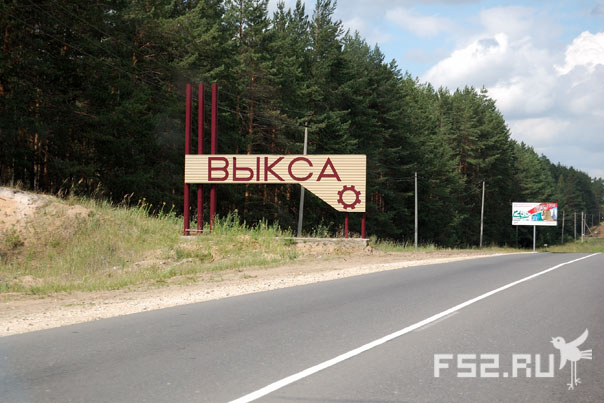
Vyksa is an old industrial city in the Nizhny Novgorod Region, Vyksunsky District.
As of 2007, the area of Vyksa is 2,124 hectares, with 204 streets and 42 lanes on which 3,455 buildings are located; the city's population is 59,600.
By early August 2010, the Vyksunsky District is engulfed by the largest forest fire in Europe.
Brief history of the city
Vyksa's origins date to 1765, when the Batashov brothers — industrialists from Tula — discovered deposits of bog iron ore (limonite) in the vicinity of what is now Vyksa. The ore was extracted using shallow conical pits called "dudki." Gradually, three metallurgical plants were built in Vyksa, staffed by serf workers. The settlement grew rapidly. Iron-working plants were also established in the surrounding areas of Veletma, Doschatoye, and Vilya. For production purposes, a system of ponds covering up to 585 hectares and reaching depths of up to 9 meters was created.
Vyksa was renowned for the skill of its metalworkers and the wealth of its industrialists. They created a magnificent landscape park complete with a menagerie, orangeries where citrus fruits were grown in winter, an artificial lake, and a theatre. Nearby stood the Batashov palace, overlooking the expanses of the Upper Vyksa Pond. In Vyksa and its surroundings, craftsmen cast the quadriga of horses and the statue of Apollo adorning the Bolshoi Theatre in Moscow, the equestrian group on the Triumphal Arch in Moscow, and the railings of the Aleksandrovsky Garden at the Kremlin. The plants produced weapons, sheet metal, nails, wire, castings, bar iron, and pipes.
In the 19th century, the Vyksa plants changed hands several times, but the new owners proved unable to improve production technology; output fell and the products lost their competitiveness. Also in the 19th century, the noted playwright A. V. Sukhovo-Kobylin and the prose writer E. A. Salias de Tournemir lived and worked in Vyksa at the homes of relatives who owned the plants. The latter authored the popular novel "The Vladimir Monomakhs," which depicted the history of the Vyksa plants and their owners.
In the late 19th century, the largest narrow-gauge railway system in Russia at the time was built in Vyksa, connecting the plants with ore-mining sites and logging operations. A significant portion of these railways survives to this day. In particular, the narrow-gauge lines remain the only link to the outside world for such settlements as Dimara, Novy Lashman, Lesomashiny, Tupik, and Domiki. The passenger train consists of two or three carriages and runs on the routes Leszavod Station–Dimara (with a stop at Novy Lashman) and Unor–Tupik (with a stop at Lesomashiny).
In 1934, Vyksa acquired city status and received a new impetus for development. Large-scale modernization of the metallurgical industry got underway: smaller enterprises (such as the plants at Vilya and Veletma) were shut down or repurposed (as at Doschatoye), while new workshops equipped with modern equipment focused exclusively on secondary metallurgy came on line at the Vyksa plant. Plants for crushing and grinding equipment (which produced armored vehicles during the war), thermal insulation materials, woodworking, and food processing also came into operation.
In the 1970s–1980s, the city grew considerably: pipe production came on line in Vyksa, serving the construction of oil and gas pipelines, as did the world's largest wheel-manufacturing facility. During this period, new residential districts were built and the layout of the city center took shape.
The products of the Vyksa Metallurgical Plant enjoy a strong reputation abroad as well: it supplies railway wheels not only to Russia but also to the United States, South Korea, India, and several European countries.
The founding family of Vyksa
The founder of the Batashov entrepreneurial dynasty is considered to be Ivan Timofeyevich Batashov, a blacksmith from the Tula arms quarter, who in 1717 built his first water-powered blast furnace on the Tulitsa River. Some researchers believed that Batashov was the manager of Akinfiy Demidov, the most famous industrialist in Russia.
Ivan Timofeyevich was known in royal circles. He had a reputation as a major expert in metallurgy. He was invited as an advisor to inspect state-owned plants. And eventually Batashov himself became a "manufacturer of iron works."
The enterprise begun by Ivan Timofeyevich was to be continued by his two sons: Alexander and Rodion. The elder son, Alexander, was not distinguished by skill in managing businesses. Rodion, on the other hand, became a successful entrepreneur: after his elder brother's death he acquired his brother's plant, "which was in a state of dilapidation," and soon built another.
The dynasty's emerging course of economic development was interrupted by a Senate decree of 1754 ordering the closure of metallurgical, distillery, and glassworks plants located within 200 versts of Moscow, owing to the threat of complete deforestation for production purposes. Rodion Ivanovich was forced to close two plants. These events undermined the health of this descendant of Tula blacksmiths, and he died suddenly at the age of 34, leaving behind two sons — Andrei, aged 16, and Ivan, aged 12.
The first plots of land purchased by the Batashov family were registered in the name of Nikita Demidov. In those distant times, only a nobleman was permitted to buy land. The Batashov family were not nobles, and so they had to use another person's name. It was only much later, in 1783, that they finally obtained noble status.
Landmarks
The principal landmark of Vyksa is the park at its very center, covering 41 hectares. It was laid out in the French style, modeled on famous European parks at Versailles, the Summer Garden in St. Petersburg, and the parks of Peterhof. The compositional axis of the park — the main linden-tree avenue — ends to the south at the Batashov manor house. The Vyksa park is a precious monument of landscape garden art which, together with the blue necklace of ponds, today lends Vyksa its distinctive and original character.
Coat of arms of Vyksa
The coat of arms of the city of Vyksa was designed to mark the 50th anniversary of Vyksa's city status. Its creator was A. A. Seppius, a decorative artist at the metallurgical plant's aesthetics bureau. The coat of arms was approved on 10 July 1984.
The coat of arms of Vyksunsky District consists of a heraldic shield measuring 30 by 20 mm, divided into four colored fields. In the upper white field is a red deer, symbolizing Vyksa's belonging to the Nizhny Novgorod Region. In the lower right corner is a complex symbolic emblem combining a cogwheel, a sheaf of grain, pipes, and a steel-pouring ladle on a red field. The steel-pouring ladle and pipes represent metallurgical production, the cogwheel represents mechanical engineering, and the sheaf represents the agro-industrial sector. The red color on the coat of arms indicates the dominant role of metallurgy in the district's industry, green symbolizes the abundance of forests, and blue represents the ponds and rivers.
Social innovations

|
In Vyksa, officials refused to provide an apartment to an 85-year-old veteran of the Great Patriotic War who was in need of separate housing, and sent the elderly man to live in a garage.
The granddaughter of the veteran — blogger Lyusya Carroll — reported the cynical incident in her online diary. We reproduce the girl's account of how her relative fought the authorities for an apartment for her grandfather in full. "My grandfather is a war veteran. A real veteran, with medals, shell-shock injuries, and a military bearing. He fought on the Karelian Front. He went to war at seventeen, marched all the way to Norway, rose to the rank of lieutenant colonel… In short, the whole family is very proud of him. Recently he saw on television that 'Putin is giving apartments to all remaining war veterans.' Despite his 85 years, grandfather somehow still trusts Channel One. Besides, grandfather has no property of his own. He lives in an apartment belonging to his daughter — my aunt — together with his grandmother, my aunt, and two student grandchildren. My aunt went to find out about the apartment. She had a curious exchange with a heavyset woman at the city administration office: — I've come about an apartment for a war veteran. Here are his documents. — I see. And what makes him indigent, this veteran of yours? Where does he live? — In my apartment. — Well there you go — he has somewhere to live! And does he have any income? — A pension. — There you are! (With delight.) He has income too! So he's not indigent! And is any property registered in his name? — A garage is registered in his name. — A gaarage! (Triumphantly.) Why would he need an apartment if he has a garage!! My aunt came home and couldn't properly explain to grandfather why he wasn't entitled to an apartment. But he had seen on television that all the veterans in Primorsky Krai had already received apartments." |

|
Vyksa and sport
Vyksa is famous for its athletes.
In 1945, K. G. Vasilyeva, who had begun her training at the city's water sports station, became USSR swimming champion. Also from Vyksa were diving champion L. S. Streltsov and sports enthusiast A. A. Zameshayev, who designed an entirely new type of kayak.
Vyksa also has its own football club — Metallurg. Its greatest achievements are 1st place in the third league (1997–1998) and 4th place in the second division (2000). Home matches are played at the Metallurg stadium. The club's main sponsor is OAO Vyksunsky Metallurgical Plant. The club's players are favorites of the city's residents.
Vyksa hosts the All-Russian sambo tournament in memory of the Batashov brothers, who are highly revered as the founding fathers of the city. According to legend, they possessed great physical strength. Thus, Andrei Rodionovich, according to historians, could still snap horseshoes "the way children snap freshly baked bagels" even at the age of 70.
Links
- forum.m-Vyksa.ru — Consumer forum of the city of Vyksa and beyond...
Interesting facts
- In Soviet times, there were no more than 25,000 cars throughout the entire region. Today, Vyksa, with a population of 86,000, has those same 25,000 cars, while in Nizhny Novgorod more than half a million are registered [1] (archive) .