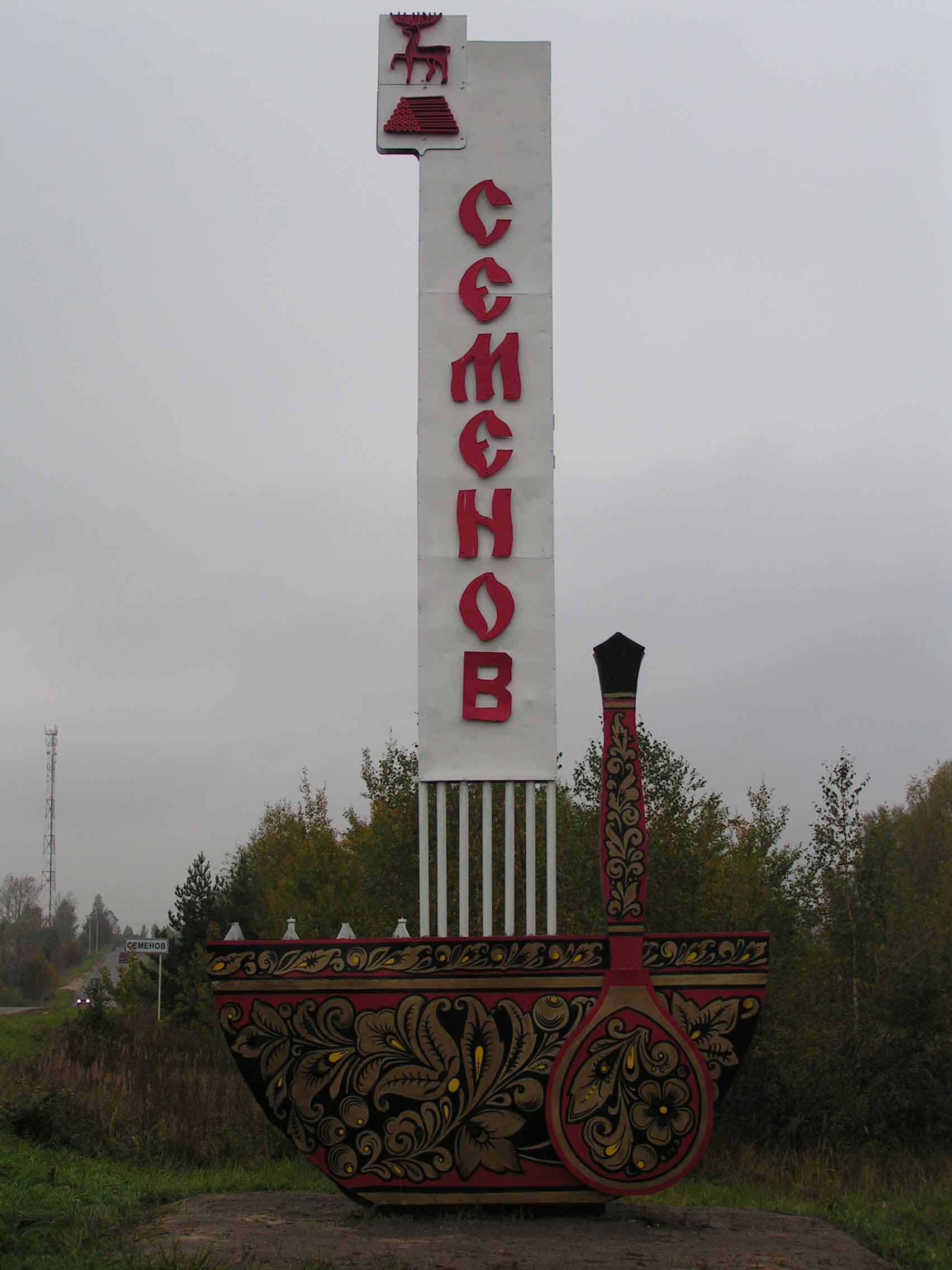
Semyonovsky District is the largest district in the Nizhny Novgorod Region. Semyonovsky District borders Voskresensky District, Krasnobakovskiy District, Varnavinskiy District, Koverninsky District, and Borsky District Districts of the Nizhny Novgorod Region. The administrative center is the town of Town of Semyonov.
History
From the 9th century onward, the first settlements of the Mari, Mordva, Meshchera, and Slavic tribes appeared on the territory of Semyonovsky District.
From the mid-17th century, settlements that survive to this day began to appear: the villages of Ozero, Pokrovskoye, Larionovo, Zinovyevo, Ronzhino, and others. At the turn of the 17th–18th centuries, a one- or two-household починок (a newly founded hamlet) arose on the site of the present-day town of Semyonov. In 1717, the hamlet of Semyonovo was elevated to the status of a selo (a larger village) when, through the efforts of Nizhny Novgorod Bishop Pitirim, the Church of the Meeting of the Lord was built there. By decree of Catherine II dated 5 September 1779, the selo of Semyonovo became a district town and was granted its own coat of arms: "In the upper part of the shield, the arms of Nizhny Novgorod; in the lower part, upon a gold field, a bonfire built in a pyramid of logs…"
Beyond the town there are numerous historic sites associated with the Old Believer faith. As early as the mid-17th century, Old Believer hermitages (skity) appeared on the banks of the Kerzhenets River. Semyonov District, known as one of the largest centers in the Nizhny Novgorod Governorate for the production of wooden tableware with Khokhloma technique painting and carved goods, also became a center of the Old Believer movement by the end of the 17th century. At that time there were 94 hermitages.
The Kerzhenets River became a sacred river for the Old Believers. Its fame grew to such a degree that the word "Kerzhenets" came to be equated with "schism," and instead of the word "raskol'nichat'" (to act like a schismatic) the word "kerzhachit'" came into use. (The life and customs of the Old Believers on the Kerzhenets were described by the celebrated chronicler of everyday life Pavel Melnikov-Pechersky) in his novels In the Forests and On the Hills; he spent his childhood years here and later visited on matters relating to the schism.) The hermitages became the richest repositories of ancient Russian art. The Old Believers brought with them into the Kerzhenets forests handwritten and printed religious books and icons. They occupied themselves with copying books, needlework (beadwork and embroidery), and icon painting. One of their principal occupations was the making of wooden tableware.
The Old Believer community gave rise to the Khokhloma craft — an original technique for painting wooden objects. In the hermitages, monasteries, and in the town of Town of Semyonov itself, they produced lestovki (prayer beads). These places were the only ones in Russia where this craft existed. The lestovki were sent to Austria and Turkey. In the 19th century, up to sixty thousand were made per year. With the arrival of the Old Believers, the felt-boot craft also developed here.
Sights
At first glance this is one of many small towns to be found all across Russia. But in reality our Semyonov is truly distinctive and unique. The name "quiet capital" — capital of the Khokhloma technique — most vividly and accurately captures its essential character.
Most notable landmarks
Notable people from Semyonovsky District
- Boris Kornilov — celebrated Soviet poet.