
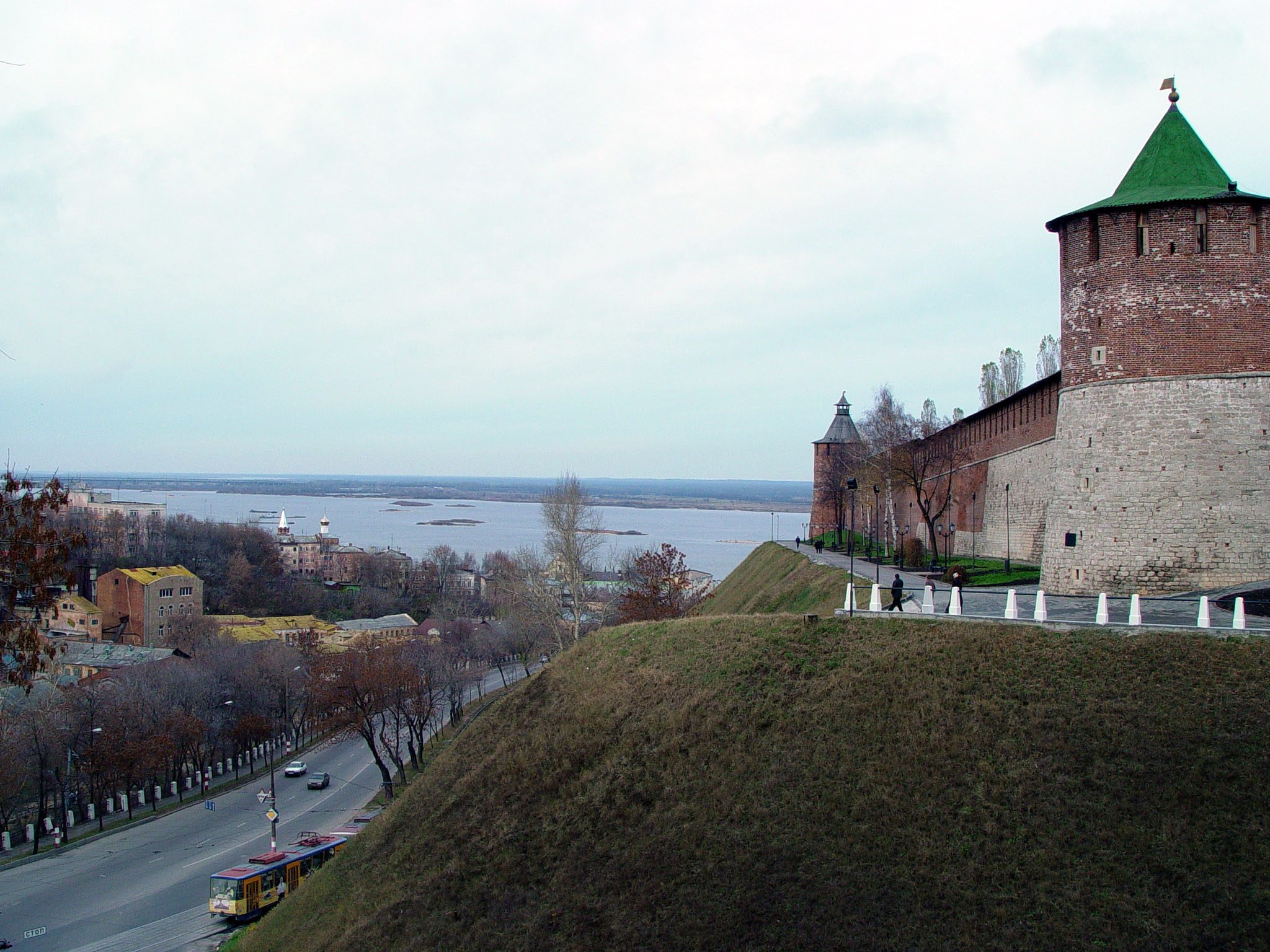
Zelensky Descent — a historic street and road passage in Nizhegorodsky District. The descent runs from Minin Square to Bracket, along the bottom of the moat that surrounded the Kremlin in the 15th century.
Another name is Truba ("the Pipe"). The name Zelensky Descent comes from the Zeleyny Dvor — a gunpowder depot and factory with a water mill that once stood nearby, on the Pochaina Ravine. Some associate the name with the green color of the descent's steep slopes. The name Truba is a metaphor highlighting the descent's distinctive feature: it is narrow.
After the Nizhny Novgorod City Duma ordered, in the mid-nineteenth century, the construction of a descent from Blagoveshchenskaya Square (now Minin Square) to the Nizhne-Volzhskaya Embankment bypassing the Kremlin, Zelensky Descent became the main thoroughfare connecting the upper and lower parts of the old city.
Nikolai Khramtsovsky wrote of it as follows: "Zelensky Descent begins between the houses of Bugrov (the theatre) and the Kremlin Boulevard. Above it, on a terrace connected to Nikolsky Lane, which opens onto Osypnaya Street, stands, among other buildings, a three-storey stone house belonging to the Nizhny Novgorod Transfiguration Cathedral. It is remarkable both for its great size and — perhaps even more so — for the beauty of its architecture. Zelensky Descent, stretching for nearly a verst, is excellently laid out: it has a very gentle slope and is therefore highly convenient for hauling heavy carts up the hill; to its right rises the kremlin, fringed by a boulevard, and to its left a hill with a terrace, which drops in a steep escarpment into the Pochaina Ravine. Zelensky Descent reaches the Lower Market just above Christmas, right by the Kazan Church."
The outlet of Zelensky Descent toward the bank of the Volga River is Shirokaya Street. In ancient times, the valley of the Pochayna river lay in its place, and for that reason the specialized trading rows of the Lower Posad market (from the eighteenth century onward, the wings of a stone gostiny dvor) were arranged along elevated riverbank terraces at some distance from one another. During the sweeping urban reconstruction of Nizhny Novgorod in the 1830s and 1840s, the Pochaina River was enclosed in a stone culvert, which was gradually filled in with earth, yet the old gap between the city blocks survived. The street that formed in this space received the name Shirokaya ("Wide") when the 1839 Nizhny Novgorod city plan was confirmed, on account of its exceptional width compared with the other lanes laid out in the area.
No. 4 Zelensky Descent was once a rental house belonging to the Bugrov merchant family. The story of its appearance is as follows. In 1883, the Bugrovs deposited 30,000 rubles in a bank so that the most popular doss-house in the city (Ivanovsky Descent, No. 2) could henceforth be maintained on the interest. But the interest proved insufficient.
In 1885, Nikolai Alexandrovich Bugrov decided to build a two-storey municipal trading block at the point where Zelensky Descent meets the gostiny dvor, whose rental income would thereafter support the shelter. N. A. Bugrov commissioned a design from the architect Vladimir Maximovich Lemke. In the summer of 1885, the foundations were laid under the supervision of architect F. N. Falin, and by early 1888 the building was complete. From leasing only the ground floor for shops in 1888, 3,000 rubles were collected. The building's total annual rent came to more than 4,000 rubles, which the authorities considered "entirely sufficient to cover the costs of maintaining the A. P. Bugrov night shelter, amounting to 3,500 rubles a year."
No. 8 Zelensky Descent is the former clergy house of the Lower Posad Kazan Church. That church was one of the oldest in Nizhny Novgorod. In 1621 it was described as "wooden, on undercroft foundations, with a porch, tent-roofed" — a fine example of a tent-roofed log church. In 1687, a Nizhny Novgorod townsman named Afanasy Olisov replaced the wooden structure with a brick church to commemorate his elevation to the rank of guest merchant (a rare, if not unique, instance of a man being elected directly from the posad into the gosti — the privileged corporation of Russian merchants who held the right to trade abroad).
The Kazan Church burned down several times, including in 1853. After the church was restored, its clergy decided to build their own two-storey house beneath the Kremlin hill. In 1867 they commissioned a design from Lev Vladimirovich Dal, an academician of architecture. The façade was rusticated — and for the first time in Nizhny Novgorod's construction practice, the rustication in horizontal bands was executed using crushed brick set in a concrete mortar, which gave the building a picturesque elegance while also being inexpensive and durable. Day-to-day supervision of the works was carried out by engineer R. Ya. Kilevein. After completion, the building was occupied by the priest and church servants.
The church itself was demolished in the 1950s, but a new Kazan Church is currently being built on its grounds, to a design by the Nizhny Novgorod architect Nikolai Pestov.
A number of curious facts are also associated with the establishments now open on Zelensky Descent — among them the well-known café "12 Chairs." It is said, after all, that it was precisely in this block of Nizhny Novgorod that Ostap Bender and Kisa Vorobyaninov stopped before departing for Tsaritsyn.
Painting the Fence along Zelensky Descent
Over the weekend of April 29 – May 1, 2017, the long fence running along the western side of the descent (the only side with a sidewalk) was painted. A curious detail: the painting was done only on the side facing the roadway.

|
Today I witnessed a classic joke brought to life — the one about how Rabinovich painted a steamship. Last weekend the fence along the sidewalk leading from Rozhdestvenskaya Street down to Lykova Damba was painted. But it turned out the fence was painted only on the side facing the sidewalk, while the other side, "where no one can see," was left as it was. And apparently to round off the general impression of the job, a little pile of the empty containers used for the painting was left right there on the spot. | 
|