
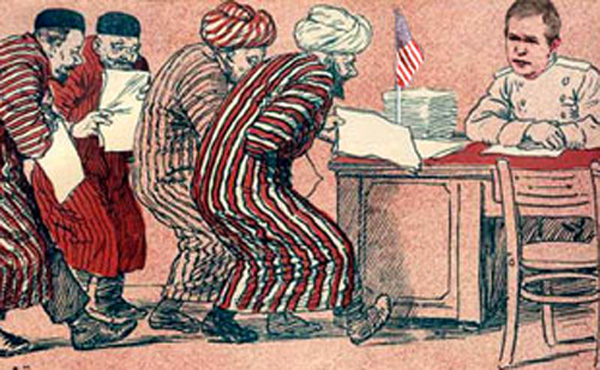
Washington Obkom — an imaginary party organ analogous to the CPSU obkoms in the USSR. A CPSU obkom issued party officials with ideological directives, particularly regarding how to speak on various matters in accordance with the party line. Failure to comply with these directives carried the risk of serious sanctions.
By analogy, the imaginary obkom in the US capital is conceived as the source of ideological directives for "conduits of American policy" in other countries.
The implication is that such "conduits" work in exchange for money and privileges provided by the United States, in analogy with the privileges of the Soviet Union era.
Literature
From the work of Nizhny Novgorod political analyst Oleg Maslov, "The Washington Obkom" — a Key Symbol in Russia at the Start of the 21st Century (Symbols and Signs of the 21st Century — Part 6):

|
"The Washington Obkom" is one of the key hybrid intellectual symbols in Russia at the start of the 21st century. Despite the fact that this intellectual symbol is actively used only by representatives of the Russian opposition, viewing reality through the lens of the "Washington Obkom" allows us to see a complete picture of the perception of reality characteristic of many, many Russian citizens.
It would be a great mistake to consider the "Washington Obkom" merely a common expression in Russian patriotic circles, intended solely to designate some Center of Power located outside Russia yet exerting a decisive influence on Russian state authority. This symbol is most frequently employed by intellectuals inclined to regard Russia as, if not an "occupied country," then unquestionably a country governed by external forces. For example, V. Militarev, one of the ideologists of Russia's "enlightened" nationalists, is convinced, if not of Russian authorities' accountability to the "Washington Obkom," then at the very least of their acting with an eye to the overseas masters of the world: "Such a political technology might be expressed in neutralizing the unexpectedly influential DPNI by co-opting its slogans while simultaneously persecuting the organization itself, in demonstrating one's own patriotism and concern for the people to the electorate while at the same time presenting oneself to the 'Washington Obkom' as the 'lesser evil' against the backdrop of 'Russian fascism.'" Not long ago, G. Kasparov, whom many in the United States consider the leader of the Russian opposition, declared during a televised debate with the "glamorous oppositionist," LDPR leader V. Zhirinovsky: "The tsar was surrounded by nothing but German spies. Just as Putin now reports to the Washington Obkom" — which allows us to speak of the wide dissemination of this symbol in Russia's intellectual space. The highest frequency of mentions of the "Washington Obkom" symbol on the Internet was recorded in January 2006, after the "gas" conflict between Russia and Ukraine was resolved. Hundreds of intellectuals, commenting on the unexpectedly settled conflict, invoked the "Washington Obkom" symbol as a symbol of the supreme power that had exerted a decisive, fateful influence on Russian President Vladimir Putin. It is precisely for this reason that analysis of this symbol is of particular interest. The "Washington Obkom" in the statements of Russian intellectuals The first thing that must be highlighted in analyzing the "Washington Obkom" symbol is its positioning as a kind of supra-state authority over Russia. Intellectual A. Dmitriev, reflecting on "Russian fascism," notes: "If everything goes well, he (Putin) will be given the green light for further suppression of Russian fascism (read: political freedoms) and the final tightening of the screws. Undoubtedly, the Washington Obkom will demand concessions — on oil and gas (negotiations on the sale of Gazprom are already underway), on Transnistria and Abkhazia, on Iran. And so on down the list." Nationalist K. Krylov positions the "Washington Obkom" as the supreme governing body for all post-Soviet states: "After the dismemberment of the Union, all the republics except the RSFSR fairly quickly adapted to the status of independent states. Naturally, they understood independence in the Soviet sense, that is, primarily as independence from Moscow and the constant extortion of resources. These skills proved useful to them in dealings with Moscow as well as with the new masters of the world, that is, with the 'Washington Obkom.'" V. Vinnikov expands the scope of the "Washington Obkom" symbol to a global scale: "Iran, Pakistan, India and China — that is, representatives of at least three different civilizations, perhaps four — are uniting, for now around energy projects, and their union is distinctly anti-American in character. The forces of the American empire are increasingly spread across a growing number of interconnected projects. So the exit of even one 'local raikom' from the sphere of the 'Washington Obkom' entails a 'domino effect' with the collapse of American influence." From this one can conclude that the "Washington Obkom" is a symbol of global supra-state power. It must also be noted that in certain Russian opposition circles many are convinced that the "power vertical" formed by President Putin is perfectly suited for the external management of the country. Political scientist A. Tsipko, one of the intellectual "defenders" of President Vladimir Putin, analyzing the phrase of former Russian Prime Minister Mikhail Kasyanov — "While in the United States, I met with politicians and businessmen. Together we analyzed various aspects of what is happening in the world and in the country. And our assessments coincided in many respects" — observes that it contains "the diagnosis of the spiritual illness that has afflicted our liberal elite, all those, and above all the leaders of the SPS, who are, incidentally, ready to make Kasyanov their presidential candidate. This phrase, above all, contains agreement with the idea that US politicians are the supreme, chief arbiters in deciding the fate of the world and of Russia. This acknowledgment also contains agreement with the colonial status of Russia, agreement that all the main questions, including the course of our domestic policy (Kasyanov said nothing about foreign policy), must be resolved overseas, in the so-called 'Washington party obkom.'" This allows us to further underscore the fact that the colonially subordinate status of Russia is directly linked to the "Washington Obkom" symbol. It should be noted that in addition to the "Washington Obkom" symbol, the "Brussels Obkom" symbol is being used with increasing frequency: "…and everything will end with the redistribution of that portion of power recognized as belonging to a 'free, democratic state' among different factions of the upper stratum, under the control of the Washington or Brussels 'obkom' (as has happened more than once in recent history)" (V. Nikitaev). |

|