
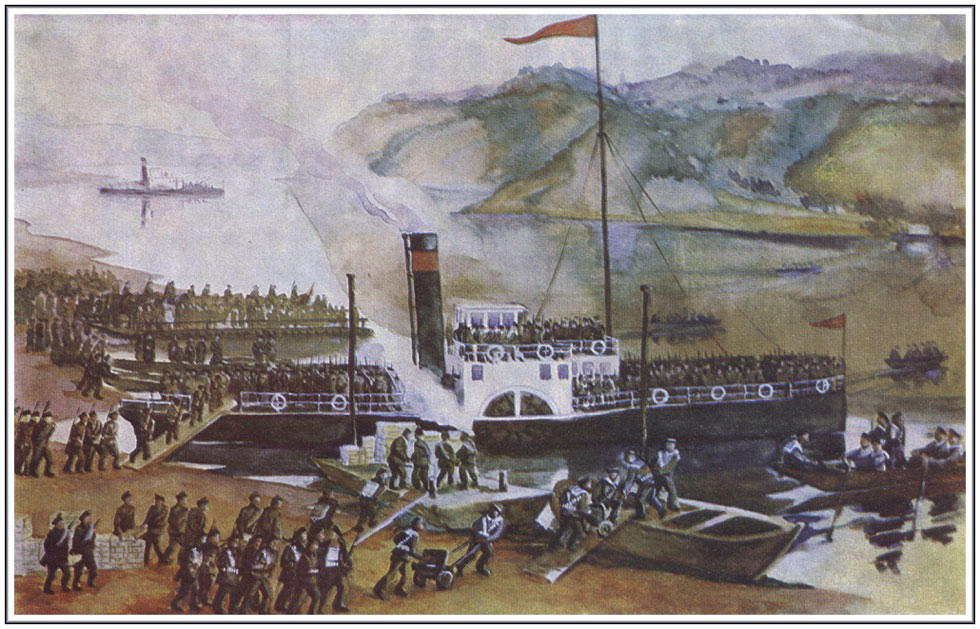
The Volga (Military) Flotilla — a flotilla in the Red Army during the Civil War and the Great Patriotic War.
History
The Civil War
In June 1918, on the orders of Lenin, the formation of the Volga Military Flotilla began in Nizhny Novgorod to combat the White Guard movement.
Three destroyers were transferred from the Baltic Fleet via the Mariinsk waterway system. To reduce their draft, their guns were removed, minimal fuel was loaded, and ballast water was pumped out. Upon arrival in Nizhny Novgorod, the guns were reinstalled within several days at the Krasnoye Sormovo Plant. In addition to these destroyers, the flotilla incorporated 5 armed Volga steamers and motor vessels, 4 floating batteries, and 4 seaplanes.
The flotilla's base was located in Nizhny Novgorod. The flotilla was organized by Commissar Nikolai Grigoryevich Markin, who subsequently became deputy commander of the flotilla. From August 23, 1918, the flotilla was commanded by F. F. Raskolnikov. From August 1918, the flotilla took part in fighting on the Volga River and the Kama. On August 28–29, near Sviyazhsk, White Guard units were routed with the flotilla's participation. On September 10, 1918, the flotilla landed troops at Kazan and provided artillery cover for the advancing Red Army units.
During the Civil War, the flotilla took part in the capture of Volsk, Syzran, Samara, and other cities. As early as September 1918, the flotilla was divided into two detachments: the Volga and the Kama.
The Kama Detachment comprised 21 gunboats, 6 patrol vessels, 1 floating battery, and 11 seaplanes. The detachment was headed by Markin. On October 1, 1918, Markin, with three ships, fell into a White Guard ambush near Pyanyy Bor and was killed. Nevertheless, the Kama Detachment routed the White Guard units and their flotilla. In October 1918, the Military Volga Flotilla joined the Volga Military Flotilla as a detachment, receiving the designation "Tsaritsynsky." During the war, this detachment took part in the defense of Tsaritsyn.
In 1919, on the Kama, Belaya, and Ufa rivers, the flotilla supported the 2nd, 3rd, and 5th Armies in defense against Kolchak's forces and in the counteroffensive. It participated in the capture of the cities of Chistopol and Sarapul, and ensured the crossing of Red Army units across the Belaya and Ufa rivers.
In July 1919, as White Guard units had retreated to the Urals, the Volga Military Flotilla was merged with the Astrakhan-Caspian Military Flotilla to form the Volga-Caspian Flotilla.
N. E. Basisty, the future admiral and commander of the Black Sea Fleet, served in the Volga Military Flotilla during the Civil War[1].
The Great Patriotic War
The Volga Military Flotilla was re-established at the outbreak of the Great Patriotic War in October 1941. It incorporated vessels from the training detachment, mobilized civilian ships (including those from the RUZD flotilla), and new armored gunboats. The flotilla consisted of 7 gunboats, 14 armored gunboats, 33 minesweeping boats, two floating anti-aircraft batteries, a railway battery, and two naval infantry battalions. Initially the flotilla was based in Stalingrad, but in March 1942 it was transferred to Ulyanovsk.
Before the Battle of Stalingrad, the flotilla conducted minesweeping of the fairway, escorted vessels, and repelled enemy air attacks on civilian ships. With the start of the Battle of Stalingrad, the flotilla was operationally subordinated to the Stalingrad Front command. During the battle, the flotilla provided fire support to defending Red Army units, landed assault troops, ferried Red Army units, weapons, ammunition, and food into the city, and evacuated the wounded, women, and children from Stalingrad. Two armored gunboats in the flotilla were equipped with rocket mortar launchers, performing the role of "Katyushas." During the Battle of Stalingrad, the flotilla lost 3 armored gunboats — two were sunk during landing operations and one during the withdrawal of a landing force. At the same time, over two months of combat operations, the enemy sank 18 steamers and 6 passenger boats from the mobilized civilian vessels, along with 12 minesweeping boats and 6 semi-gliders.
During the battle, the flotilla's artillery destroyed 3 enemy infantry regiments, 20 tanks, 13 aircraft, 100 field fortifications and bunkers, and 26 enemy artillery batteries. Approximately 90,000 soldiers and officers were ferried into the city, along with 13,000 tonnes of cargo. Some 52,000 people were evacuated from the city.
For the courage and heroism displayed during the battle, the 1st and 2nd armored gunboat divisions were awarded Guards status, and the gunboats Usyskin and Chapaev were decorated with the Order of the Red Banner.
Disbandment
After the Battle of Stalingrad, the Volga Military Flotilla retained two minesweeping brigades, which in 1943–1944 carried out mine clearance and the protection of navigation. The remaining vessels were transferred to the Dnieper and Azov Military Flotillas.
In June 1944, the Volga Military Flotilla was disbanded.