Nature of the phenomenon
The declaration of support for "Plan Putina" was one of the central elements of the United Russia party's election campaign ahead of the parliamentary and presidential elections of 2007 and 2008, respectively.
The conceptual basis of "Plan Putina" was first elaborated by APEC Director General D.I. Orlov in May 2007. According to Orlov's concept, Plan Putina encompasses the development of a national model of democracy, a one-and-a-half-party system, a just society, an innovation economy, a focus on large corporations, the consolidation of the "Russian world," and institutional continuity.
History of the plan
The term "Plan Putina" was introduced into political circulation by the Chairman of the Supreme Council of United Russia, B.V. Gryzlov.
On 22 May 2007, at an enlarged session of the Supreme Council and General Council of United Russia, B.V. Gryzlov delivered a political address on the topic "On the Implementation of Plan Putina by the United Russia Party."
Intellectual property of the party
On 26 February 2008, the Sverdlovsk Regional Court ruled that the phrase "Plan Putina" is not the intellectual property of the United Russia party and permitted Russian citizens to use it at their own discretion. The case arose from a challenge to the electoral commission's decision to pull campaign advertisements by independent mayoral candidate in Yekaterinburg, Aleksey Yesaulkov, which used the phrase "Plan Putina" without United Russia's permission. The electoral commission had argued that Yesaulkov had no right to use the phrase, as it was the party's intellectual property. The court, however, rejected the commission's reasoning.
The party A Just Russia also played on the slogan, rendering it as "Plan Putina — the victory of justice."
The brochure with the plan
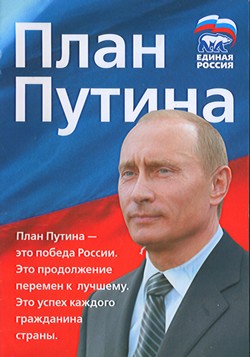
In addition to appearances in slogans, there also exists an illustrated brochure entitled "Plan Putina," which began to be distributed free of charge as campaign material ahead of the 2007 State Duma elections.

|
The goal of Plan Putina is Russia's victory. Victory over poverty and corruption, over economic and technological backwardness. Victory in the competitive struggle among the world's leading powers. The result of this victory will be Russia's rightful place in the international division of labor and distribution of wealth. Russia's victory means a new architecture of the world — one in which our country will be able to influence global policy for the sake of its citizens' security and well-being. | 
|
The brochure has three sections devoted to three stages of "Plan Putina": "Restoring Order," "Concentrating Resources," and "Developing the Country." Each section opens with an extended quotation from Putin; statements by United Russia leader Boris Gryzlov are also included, though the bulk of the text consists of anonymous theses.
The brochure identifies five paragraphs:
- Preservation of the people. Safeguarding the richness of the language, traditions, and cultural space; developing education and culture.
- Building a competitive economy. An innovation-driven path of development. Support for sectors that serve as locomotives of the economy. Infrastructure development. Support for small businesses.
- A new quality of life for citizens. Continuation of national projects. Raising wages and pensions. Addressing housing problems.
- Civil society: realizing the interests of every individual.
- A sovereign state. The vertical of power. Modernization of government. Combating terrorism.
Plan Putina in United Russia's program
In United Russia's electoral program for the 2007 parliamentary elections, "Plan Putina" is formulated as follows:
- the further development of Russia as a unique civilization, the protection of a shared cultural space, the Russian language, and our historical traditions;
- raising the competitiveness of the economy by transitioning to an innovation-driven path of development, supporting science, developing infrastructure, and increasing investment — above all in high technology and in the sectors that serve as locomotives of economic growth;
- ensuring a new quality of life for citizens through the continued implementation of priority national projects, further and substantial increases in wages, pensions, and scholarships, and assistance to citizens in resolving their housing problems;
- support for civil society institutions, stimulating social mobility and civic engagement, and promoting public initiatives;
- strengthening Russia's sovereignty and the country's defense capability, and securing for it a rightful place in a multipolar world.
Putin on Plan Putina
On collective responsibility
|
|
Speaking at the congress, Putin commented on the so-called "Plan Putina," upon which the United Russia members are building their electoral campaign. "You have tied your party strategy to the name of the incumbent president — your humble servant," the president began.
"I suppose that from the standpoint of electoral logic this may make some sense, but I am not sure that this plan needed to be so personalized — especially since its author is not a specific individual but a large collective," the head of state said. Putin noted that the plan was essentially the product of the work of the government, regional and local authorities, the Central Bank, and both chambers of parliament. "That said, it is beyond doubt that without the decisive support of the leading political force — your party, United Russia — we would not have been able to implement this plan," the president said. "We would not have been able to give it concrete form in laws, decrees, and government resolutions," Putin added. He also recalled that virtually every step forming the foundation of this plan had been widely discussed. |
|
Where the plan was conceived
|
|
This slogan wasn't my idea — it was genuinely invented by United Russia. The point is, essentially, that in all of the addresses to the Federal Assembly over the past seven years, in virtually every one — certainly in the last five — there was a key section of the address devoted to the development of one or another sphere of state activity over the medium term. The economy, the social sphere, politics, international affairs.
Each year there was some principal section. And if all of these principal sections were arranged into a coherent system, they could be regarded as a plan for the country's development over the medium term. I spoke about this in my address this year. I said outright that if we look at everything that has been formulated in the addresses over recent years, we will see that this is indeed a plan for the country's development. But they, in the context of the electoral campaign, formulated it as "Plan Putina"… It enjoys the support of the population. I was just telling Nikolai Zlobin, in answering his question, that in a certain sense this "plan" contains a great many issues of a social character. Positioning Russia as a country pursuing an independent foreign policy is also supported by the overwhelming majority of the population. Taken together, all of this gave the party the opportunity to formulate it as "Plan Putina," bearing in mind also the rather high approval rating of the incumbent president. That is how things stand today; yesterday they may have been different, and tomorrow something may change again. But in the course of an electoral campaign, from the standpoint of those who craft these slogans, it is apparently quite justified. I have no objection to it. |
|
Plan Putina in action
According to some Nizhny Novgorod residents, one of the most successful projects has been the implementation of the The Cheboksary Disaster. The results of the 1930s–1940s, however, were never matched.
Public opinion
In late September 2007, VTsIOM conducted a sociological survey, the results of which revealed that at that time 70 % of respondents were unable to say what "Plan Putina" actually consisted of.
12 % of respondents (among those who knew or had heard something about "Plan Putina") believed that such a plan was needed by the country and should be put into practice by Vladimir Putin himself (7 % of those who knew or had heard something about "Plan Putina").
Interesting facts
- Plan Putina soon began to be called Mein Plan, by analogy with another well-known book.
- Following the Russian national football team's victory over England on 17 October 2007, a piece appeared entitled "McLaren's Plan — Russia's Victory."