
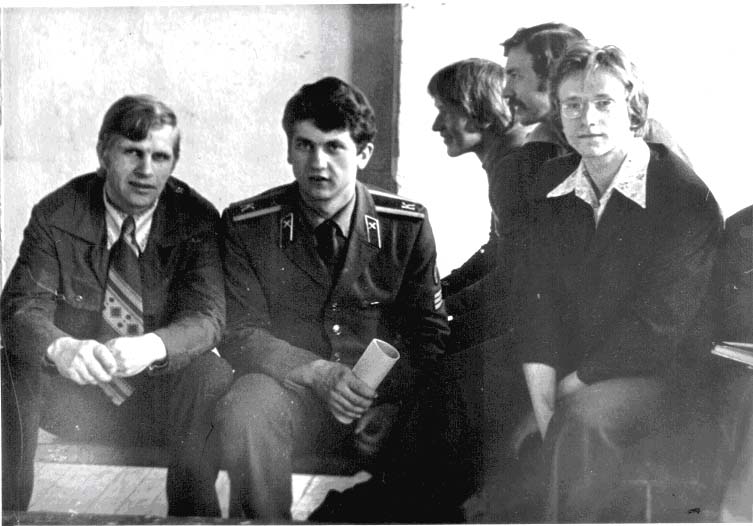
Gorky Karate — karate that was officially permitted and later driven semi-underground in The City of Gorky.
A survey of the early stages of karate's development in Nizhny Novgorod, 1968–1992, by Aleksey Gruzdev at wudao.narod.ru, with commentary by Igor Zelenov.
Nature of the Phenomenon
For the author of these lines — a direct participant in those distant events — it matters to convey that particular spirit which prevailed in people's minds and hung in the air, and I hope not only in me and around me.
However naïve and primitive these events might appear from today's vantage point, I want to stress that they are significant only in terms of cultivating the inner spirit. A great deal of criticism has been directed at the organizers and at the central figure — A.D. Chastukhin, who in those years bore the "weighty title" of Sensei.
Those were the years of my youth and coming of age, and my principal Teacher was my own Spirit — awakened, of course, by "older comrades," yet still, a quarter of a century on, pursuing the same independent strivings and search. There is no need to drift into lyrical language, but in the end the experience of years gone by is worth something. At the time the Sensei was thirty-one, and it seemed then that a long road as vast as a lifetime stretched ahead. That is precisely what one should be held seriously accountable for. It is a bad thing when a person has no memory and no conscience — bad for others, though very convenient for himself.
Some are gone, others are far away. The road has long since vanished from view, and few have remained on it. Then again, as the statistics of all subsequent years of training have shown, this is normal. Unfortunately it took a great deal of time to grasp things now considered obvious: what cannot be bought for any amount of money is easily purchased for an idea or a faith. So never mind the "older comrades," for it was they who were the first to stray from the path, skimming off the cream. The lessons of the past matter most to those who live in the present — those who are searching for themselves and understand that beyond "earning a living" there is, in that very life, still room for Work. Criticism directed at me is fair; many names have faded from memory and there may be some errors, but I declare that I have permitted myself no false accusations, since all these events passed through my heart. An objective assessment of "that work" is now more important than any settling of scores.
The author would propose an alternative title: "The Role of the Individual in History, or: The Homeland Must Know Its Heroes." Let that stand as my first joke here; we will leave the original title as it is. As for why I have given Gorky Karate the life dates of 1974–1982 — read on and you will understand for yourself.
Chronicles
- 1968. In Pavlovo, Arkady Dmitriyevich Chastukhin (born 03.12.48) organized the first karate-do section (after returning from the army). They studied scattered techniques, learning about karate mainly from the mass media.
- 1970. A.D. Chastukhin took part in a karate seminar led by Rudolf Katsenbogen, held in Kyiv.
- 1973. The first ban on karate. However, there were no harsh sanctions, and training continued without much publicity. (In 1972, Chastukhin enrolled in the preparatory faculty of GGU and moved into the university dormitory.)
- 1974. Arkady Dmitriyevich (1974–1979 — studying at GGU, biology faculty — I.A.Z.), with the support of Alexander Ivanovich Gavrikov (then aged 28, born 1946 — I.A.Z.), at the time an associate professor at the university, formed an initiative group of students and faculty at the gymnasium of Gorky State University named after Lobachevsky. Initial attempts were made to systematize the karate-do curriculum and teaching methodology.
- 21.10.1979. "Budokan," before the examination — the upper hall of the physics faculty of the pedagogical institute; from the windows one can see the entrance to the Nizhny Novgorod supermarket. [The photograph is placed slightly out of sequence chronologically.] To whom is the bow directed? — To A.D. Chastukhin, "sensei ni rei!": Kolyadyonkov V.I. to the right of the line, in the role of sempai; then, from right to left — O.I. Makarov, S.I. Savenkov, L.N. Kuzmin, "Pavlovo," V.I. Zerin, S.V. Silantyev, A.I. Kibets, A.I. Vinogradov, V.V. Yarkov, P.P. Meleshnikov, S.V. Grebenshchikov, A.S. Demidov, "Pavlovo," an acquaintance of Demidov — his assistant for the examination. The "Pavlovo" men: Ryzhov V.V., Korolev A.N.
- 1975. Training moved to the School of Advanced Sporting Mastery. Chastukhin's best student, then a senior engineer at the Krasnoye Sormovo Plant, Vladimir Ivanovich Kolyadyonkov (born 21.02.53), began actively assisting with karate classes at the boarding school in the settlement of Rykovo. The Czech shotokan karate-do programme was adopted as the basis of the training system.
- 1977. In January, A.D. Chastukhin conducted the 1st grading examination under the shotokan school.
1978. Arkady Dmitriyevich handed full initiative over the conduct of training to his student V.I. Kolyadyonkov. Under Vladimir Ivanovich's guidance, S.I. Savenkov (born 20.07.50 — died 11.02.2000), N. Solntsev, O. Kupriyanov, A. Alelekov, V. Tupitsyn, V. Antonov, Ye. Morozov, N. Ustyuzhanin, N. Yeryomina, and O. Makarov trained and went on to become well-known instructors.
- In August 1978, I — I.A.Z. — and my cousin Sergey learned from the Paltsev brothers of the existence of an "underground, practically cave-like hall" where a certain teacher, Arkady Chastukhin, taught Karate. The elder brother, Mikhail Paltsev (born 1954), worked at Krasnoye Sormovo assembling ships — and it was he who had come to know that engineer Kolyadyonkov, who instructed the elder Paltsev to assemble a group and find a venue for training. This became the first new junior group outside the walls of the main hall. The venue was a school in the Narodny settlement in Sormovo. Classes began in January 1979. The school provided us with Aleksey Stepanov (born 1960) as instructor; he then held a green belt (5th kyu).
1979 — but where is he now, that young man? It was a very serious year… Work, work…
In those days the people who came to the hall were first and foremost those who carried inside them a certain "string" of warrior spirit. What drew them was not mere exoticism but a search for something within themselves. Then again, I cannot speak for everyone — in this case I speak for myself. Looking back now, you understand that those were the best ones. But it was the seventies — the dead silence of socialism. The "changes" that touched people then far preceded the future changes and determined the fates of many of those who came to the "Budokan" in those days. This, of course, refers only to an inner state. In the photograph: Vadim Yarkov, born 1962, my good friend at the time — a talented and industrious young man, the first to receive the 1st purple belt (having passed 5th kyu) while still under eighteen (the photograph shows that examination, dated 19 January 1980). Well, you can see it for yourself. But his path through the school turned out to be a very difficult one.
- 1980. The first Gorky City Federation of Sport Karate was established. A.I. Gavrikov was elected chairman; S.I. Savenkov, deputy chairman. Chastukhin worked as a civil-defence engineer at one of the vocational schools in the city of Gorky.
How did the problems of the school — the "Budokan," as the training centre was known — begin? The truth is simple and banal. Just as Muscovites in The Master and Margarita were ruined by the housing question, here, as usual, everything came down to money. The material and the immaterial were put to the test and did not always pass. As the Sensei was fond of saying: "Life is the best karateka — it always strikes where it hurts most." The fish rots from the head; all grievances should be directed at the management of "this bazaar."
S.I. Savenkov and V.I. Kolyadyonkov became students of the Japanese master Tetsuo Sato. Here, then, is the real continuation of the divergence of views on training. The "ruling elite" in the person of Chastukhin, and the "emerging opposition" in the person of the sempais. On the one hand, the lads — Savenkov was thirty at the time, Kolyadyonkov twenty-seven — having caught a glimpse of more or less genuine masters and come back home, found the same Chastukhin waiting for them. On the other hand, a leader is always needed to set the direction of movement — not only the outward direction but, just as importantly, the inner one. The core problem for these people (and thus for the school) was that nothing of this kind had ever existed here before. Everything was happening for the first time. Being first is always hard and carries great responsibility. The story of the Vogralik father and son is further good evidence of this.
At the invitation of Teacher Sato, the great master Mazo Iwata came to Moscow, conducted a training seminar, and examined candidates for black belts.
As the years have shown, genuine specialists and good masters never leave their homeland. One must go to them. This, however, applies not to Sato or Iwata but to more serious currents and schools — Chinese ones in particular. But that is another story.
V.I. Kolyadyonkov and S.I. Savenkov were the first in the region to receive instructor-trainer certificates at the All-Union karate-do coaches' attestation in Moscow, and upon returning home organized classes at the DSO "Burevestnik" and the DSO "Dynamo."
- 1980–1981. A network of halls across the city. S.I. Savenkov acts as sempai at School No. 4 on Lyadov Street. The group's prefect Chernov V.A., Vadim Yarkov, and I — I.A.Z. — help Savenkov run the sessions. Yarkov's nickname among the practitioners is "Kentes." I don't know my own — probably "Dzarey." A large group at School No. 2 on the Strelka. I go there at the request of the seniors and conduct "explanatory work" — solid dzarey, up to 500 repetitions. In the second half of the year the senior group trains at a school in the Kanavinsky District, not far from the circus. I acquire my own small group in the Sormovsky District at a school near the 5th vocational school. I bring them up to the examinations; some of them subsequently merge with the senior group. The groups in various locations are led by the finest people of the school at that time — not without ambition, lacking sufficient experience, but as a rule people who "burn inwardly." As I have said, for all the differences in character and worldview, these people shared something in common within themselves.
- The year 1980 is remembered for bows — DZAREY. A.D. Chastukhin, seeing the slovenliness of the students, introduces this practice. It took place in the lower hall of the "Budokan." First "mokuso" — quiet sitting in seiza — then 500 dzarey, rising into kiba-dachi and standing, followed by another 100 dzarey at the end. The whole thing lasted up to three hours. This practice drove many a "devotee of the empty hand" away as if by a strong wind. Only the most committed came, as if going into battle. "Are they still doing dzarey?" — a very topical question at the time among the absentees. What can one say about it? Honestly — the truth. Kolyadyonkov V.I., arguing with "the boss" (as we called Chastukhin twelve years later when we worked together at the private enterprise "ADCh") on various matters, was the first in my presence to receive 1,000 dzarey. "First come the best cuts, and… the bones and offal for the rest." Anyone who has never done it has missed out on something significant. I attempted the "1,000" three times; the longest session ran to three and a half hours. Having "earned" 300 dzarey the very first time — even before the "great month-long dzarey practice" — and having already completed half, I was joined by reinforcements in the form of "elder brother" Meleshnikov P.P., who had received his own 500. "Palyich," sitting down quietly beside me, observed softly: "Never mind, we'll start over together now." And so we did, unhurriedly, from the beginning. By the end of the ordeal I was a mess — snot, saliva, the works — having received the full treatment. Believe it or not, I attended every day throughout the month of the aforementioned "dzarey punishment," which was afterwards exploited mercilessly.
The enormous halls at the Polytech and at the school near the Palace, at the start of Beketovka, are remembered precisely for the inner load they imposed: dzarey, "mokuso," "kentes." Nothing like that exists today, but in those days many people came and stayed solely for that reason. To overcome oneself. Truthfully and without retouching.
And of course, those who remember will recall the trips to the settlement of Dubravny with sempais Kolyadyonkov and Savenkov. Cross-country runs, our glade, mosquitoes and horseflies, forest makiwaras, the Olen sports base, a bit of football, and of course the "Kozinsky waterfall." The first time we were taken there by Rodkin V.N. in the back of his work lorry, and the waterfall became a favourite spot — and, incidentally, remains so to this day.
Now you understand that the main fork in the road was, as it always is for people, the choice between the material and the immaterial. Some broke, some got lost, some never understood anything, some knew clearly what they needed. Questions whose answers only came a quarter of a century later stood like "concrete barriers" even then. And those for whom the answers were necessary went forward in search of a reply to that eternal central question — "What is to be done, and how?" Disagree? That is your right.
- 1982. In September, the 1st kata competition was organized at the Trade Union Sports Palace. The champions were Kuzin and Bonetskaya. In December, a kumite competition was held on the Dynamo premises: 1st place in the under-70 kg category went to Kuzin; under 80 kg — to Sorokin.
- 1983. Official closure of karate. At TsSKA and the Central Council of "Dynamo," in order to avoid a conflict with the law, the term "hand-to-hand combat" was invented as a substitute for the word karate. This innovation was supported by V. Antonov and V. Tupitsyn — among the first karateka to retrain as hand-to-hand combat coaches.
- 1989. The first attempts to rehabilitate karate, at a martial arts festival in the city of Gorky organized by V.I. Kolyadyonkov and N.N. Ustyuzhanin.
The arrival of the "great" Maslov, conversations about inner work with listless demonstrations on the grounds of the Police Academy at Schelokovsky Khutor.
- 1990. Classes in shitoryu resumed and were held at the Law Institute until 1992.
- 1991. The Karate Association was established. V.I. Kolyadyonkov was elected president.
At the gymnasium of the law institute, V.I. Kolyadyonkov created one of the strongest clubs in the region — "BUDO." The club's members included A. Gruzdev, A. Lukutin, D. Bykov, A. Gorda, V. Kuzmenko, I. Kazachkin, A. Kudaryov, and others.
In September, a seminar and grading in shitoryu took place in the city of Gorky, led by V.A. Dubinin, President of the USSR Shitoryu Federation.
- 1992. On 29 March, the Karate Association, jointly with the Regional Sports Committee, organized the All-Styles Regional Karate Championship at the Trade Union Sports Palace. On 24 May, the 1st Russian Karate-do Shitoryu Championship was held in the city of Gorky.
- 1994. The Association was reorganized into the Nizhny Novgorod Regional All-Styles Karate-do Federation.
Excellent — some things need correcting, some adding. All in all, praise to those who remember and do not forget. Not everyone loves history. Some have left good things in it, others bad. Who shall judge? — The Lord God (forgive me, with no sarcasm or hidden agenda whatsoever). What is to be said will be said TRUTHFULLY, for there is no longer any point in lying. And it is not good — to lie.
An objective assessment of "that work" is now more important than any settling of scores.
Our goal is as follows. Drawing on twenty-five years of practical experience — neither diminishing anyone's contributions nor concealing mistakes, and relying on substantial information and personal findings — we aim to analyze the history of Eastern systems as they developed specifically in the City of Gorky and its environs. We intend to analyze, in particular, the development of Sinology in Russia as the most foundational science of the East, being a projection of the Eastern traditional mother-system of knowledge encompassing everything we associate with the concept of the East. We wish to point out what we regard as a lopsided view of the subject that has taken hold. We also wish, at last, to shed light on certain things that have still not "gotten through," and to broaden our "Nizhny Novgorod horizons" — especially since we know people who came from our region, achieved remarkable results, and remain, to this day, unjustly unknown.
From the perspective of internal alchemy, work was conducted exclusively on SIN (fire, heart, spirit, the upper body), to the detriment of MIN (water, kidneys, energy, the legs). This is clearly visible in the height of the stances, the tempo, and the speed of movement. In favor of SIN are the "zarei" performed, the mokuso — "empty sitting" (which nevertheless led me to a remarkable result; see here), the "kentes," and other techniques that temper the spirit while neglecting the body's energy — the foundation of real strength, as opposed to illusory strength. Shmakov K., who once dropped by, remarked even from the doorway: "Karate is form." It is simply impossible to disagree with him; true perception of a subject sometimes comes only after years. The lion's share of "Eastern adepts" work with SIN, and among them one encounters quite worthy masters of SIN specifically. But the consequences of competitive work have negated everything worthy of attention, even in terms of SIN. The spirit is gone. The sporting spirit clearly bears no resemblance to what once existed. True, Kolyadyonkov makes his "disobedient" students lap from the bucket used to mop the dojo floor, if it was not cleaned properly. Exceptions to any rule have always existed and always will, but they only confirm the rule. The pursuit of belts, the pursuit of trophies, sporting glory — personally, I wouldn't want any of it even as a gift. All the more so once it became clear that confining oneself to SIN alone is tantamount to death — which, incidentally, is obvious enough from life itself. The contribution of Vogralik and Chastukhin lies in their ability to break "virgin soil" that had never been plowed before them, and that, perhaps, is all. Those who grew up on that foundation have long since surpassed their "teachers" in every respect. The negativity is rooted above all in the individual himself — in Chastukhin, for example. Money should be earned through money, not through faith. "Render unto Caesar what is Caesar's." One must know history, since one must move forward oneself and not hold others back. It is always better to learn from other people's mistakes.
Chastukhin and Kolyadyonkov are the two main protagonists of "Nizhny Novgorod karate." Most often, Chastukhin was accompanied by Kukin V.V. (Pavlovo). I had the "good fortune" of sitting in examination only once, and even then it was with Kolyadyonkov — I was young at the time. Later, working at "Nephrite," I administered dozens of karate and wushu examinations. I appreciated the examiner's role from personal experience. "Beyond the glory and fanfare," it is above all a responsibility — the ability to remain impartial, and not least the stamina and capacity not to lose one's composure. To put it simply: if you're falling asleep, dropping from exhaustion — fall where no one can see you; if you've arrived crushed by grief — don't inflict it on anyone else.
What those "tameshiwari" meant at the time! It may not seem so vivid now. But back then you weren't just driving your fist through boards — you were driving it through yourself. You had to overcome yourself. And people did. They struck so hard that splinters flew. The occasional absurdity was unavoidable.
The dates of the main examinations in which the author personally participated, or attended as an assistant, or simply watches from a distance — events that now belong to a receding history still dear to the heart. Our youth was passing then — sincere, honest, and how sorely that sincerity was missed afterwards. Never mind what came later; what matters more is the state of Spirit in which we lived in those days. Feel it. Out in the world, Brezhnev's socialism held sway, yet freedom was there in abundance. Young people today do not have that. Men, to horse.
Examinations
The date of the 1st examination and all subsequent ones up to 6 May 1979 are unknown to me, and it is unlikely that anyone could name them now — in those days no one thought about history; they were making it. Yet judging by Kalyadyonkov's examination for 4th kyu, there may have been as many as four or five such unrecorded examinations.
6 May 1979. Budokan, lower hall. First examination, testing for 8th kyu. The main figures finally emerged: examiner — A.D. Chastukhin (sensei) and V.I. Kalyadyonkov (sempai), who was then testing for 4th kyu (Heian Godan). Of the entire "People's School" group, which numbered up to twenty, six people came to the examination: Yarkov V.V., the Paltsev brothers M.K. and N.K., the Author — ZIA, and two others who subsequently sank into oblivion.
That is "us" in the photograph, 21 October 1979 — long ago, yet like yesterday. Third from the left: Tupitsin V.A.; fourth from the left: Minin M.V.; fifth: Zelenov I.A.
28 July 1979. Budokan, lower hall. 13 October 1979. Budokan, lower hall. 21 October 1979. Budokan, lower hall.
19–20 January 1980. Budokan, lower hall, upper hall. Below — a "historic photo"! 19 January 1980. Lower hall. The examination was large and lengthy. From left to right: Silantiev S.V., Gerasimenko D.M., Zelenov I.A., Krasnov V.A., Minin M.V. in motion. Krasnov Valery (born 1948) is consoling me — ZIA. I had not passed my examination with distinction. Another talent: the following year Krasnov, by arrangement with Chastukhin and G.G. Protsenko, brings the latter to Gorky. And so it begins — Yoga, India. Who knows about this today? Who remembers those who were the first to start, and who paid the full price for it? The KGB did not sleep in those days. Incidentally, Krasnov was the first person to understand what lay behind the personality of Sensei Chastukhin — and left. Yoga was banned even before Brezhnev's death. It was alien to us Soviet people. Krasnov was the one held responsible. When Nizhny Novgorod's yoga practitioners sit in the lotus position today, they probably do not know that those closest to its spirit were our fellow townspeople back then, in the distant year of 1980. People were searching… Well, now it is probably fashionable. Incidentally, in our "gentle work," here in 2005, we also sit in the lotus for up to one hour — "empty work," as alchemy calls it, but it must be done…
26 April 1980. Budokan, upper hall. 14 June 1980. 28 June 1980. 27 July 1980. School No. 23, Kuznechikha. The funeral of V.V. Vysotsky in Moscow. In the photograph below — my examination for 5th kyu.
The warmest examination of all. Photographed by Yarkov V.V., who managed to get away from his duties. He had been posted to serve here, at the GVZRU — and that became his catastrophe within the school. Had he been stationed far away, he would have remained intact; instead he was holding classes at the academy by arrangement with everyone involved. He put the "commanders" through their "kentes"; I used to go to him and lend support, but could not see it through to the end. The anti-aircraft political officers set him straight — we had socialism back then, and we had stepped out of line.
My first "breakthrough" — I didn't feel a thing. "Like a tractor drove through," Vadim said at the time. I asked him why the shots turned out that way. "You moved so fast that catching the final moment of kekomi was impossible" — that was his answer. After my own examination, during the break before the junior candidates, I meet Kolya Ryazanov and we go off to "knock back a few" at the nearest shop. The heat was unbearable, God help us! Here is someone worth remembering! Nikolai Ryazanov, born 1960. One of the talented ones. Sadly, he is already gone — died tragically. How many joint sessions, conversations, and plans we had afterwards…
It is to such people — to their memory — that I would like to dedicate this site…
Some are gone already, others far away… To be first is always hard. They do the bulk of the work. Seen in this light, the great foreign masters evoke a warm smile. Bring them here — without any genealogical tree, into our winters, into our well-fed socialism. Oh! What am I saying! And yet, what has changed? It seems that the Tradition of something Great has long been putting down roots among us. Nobody has told you this; we will argue about it again — and yet we agreed not to lie. Listen carefully — it is worth hearing…
21 September 1980.
2 November 1980. Budokan, upper hall. 8 November 1980. January 1981. The school at "Varya station" — the first signs of approaching change in the school, at least for me. 8 February 1981. 15 March 1981. Budokan, upper hall. Hall of PTU No. 6. 21 March 1981. Sports hall No. 2, VPI. 1 November 1981. GIPT hall at Avtozavod. 16 May 1982. Olen sports base at the Dubravny settlement.
Unfortunately, those who were keeping records of the examinations at the time were shirking the job, and the rest of the rather interesting events can no longer be accurately reconstructed. How many unrecorded examinations and occurrences there were! Nobody thought about history back then. As the saying goes, "the motherland does not know her heroes" — though she remembers athletes. V.V. Kolyadyonkov, taking his 1st kyu examination before the same Chastukhin, broke boards suspended in mid-air during tameshiwari. Yes — by my time, Chastukhin was no longer conducting classes himself. But the claim of a complete break from Chastukhin's influence as a personality as early as 1978 is utter fiction. All the more so, since who actually knows what happened afterwards? Do you want to hear? Come with me, further ahead…
Commentary by Igor Zelenov
Among the people mentioned by Gruzdev there are good fellows, but "off camera" there remained people far more interesting, deep, and serious. Not all of them will be named here — let my reasons for that remain known only to me — but it is necessary to shed light on the true history of "Nizhny Novgorod karate." For the sporting achievements so thoroughly chronicled by the respected Aleksei Gruzdev bear no comparison to what those "Gorky karateka" I am happy to tell you about have achieved and arrived at. All the more so since competitive karate of any kind never interested me — not even with the suffix DO attached. That "suffix" has come to hold a far deeper and more precious meaning for me, and has long since ceased to be associated with karate-do at all.
- 1980. The first Gorky City Federation of Sport Karate was established. A.I. Gavrikov was elected chairman; S.I. Savenkov, deputy chairman. — So what [who cares]? What can that mean to anyone now? Athletes!!! … PEOPLE WERE SEARCHING FOR THEMSELVES. At the turning point of eras and upheavals. One person, however, expressed this better than anyone:
I am guilty, endlessly and all around, before those
With whom it would be an honor to meet today.
But though we have flown to the end alive,
Memory scorches us, and conscience torments those who have one.
Someone counted out our hours, sparsely and precisely,
In our short life, like a concrete runway.
And on it some were broken, some took flight forever,
While I — I landed. There's the trouble.
August 1982. A trip by a "detachment of Gorky karateka" to the Sea of Azov "for tomatoes and pears." In the history of the Budokan, this was the second joint trip with the "sensei" to the south. I was not on the first one, but I heard plenty about it — in particular from Zerin Vyacheslav (born 1948). Those present on the August 1982 trip included the Chastukhins themselves (both — A.D. and his wife O.E.), Kolyadyonkov V.I. with his young son, Chernov V.A., Ustyuzhanin N.N., Bonetskaya O., Morozov E., Styodenov V., Kupriyanov O., Pinkhisovich, Lapkovsky… We were there too — ZIA. A truly epochal event, one that vanished entirely from "the historical annals." Let us "catch" it and put it on record.
The principal outcome of the trip was the separation of the inner circle of people connected with Chastukhin — as the chief ideologist of the work to come — from the sporting group of Gorky karate. It also marked the de facto beginning of work in Gorky with Chinese systems. But things did happen on the Azov. Chernov V.A. was there — a man I hold in great respect. What karateka can look forward to something like that today? There was an evening gathering by the sea, around a bonfire at the very end. And that evening decided everything. The athletes remained athletes — good ones, at that. Everyone who wanted something more went with Chastukhin. That, incidentally, is something one could call him to account for today. Well, chief — do you remember? People believed in something. They rightly say: "Make no idols." Well, athletes have their share of trouble with that too. Years have passed; there was no mistake — each person remained true to themselves, if they were able. Keep working, gentlemen…
In the top photograph not all the "vacationers" are present, and I am not there either — I had taken offense at something, young as I was, and had swum out to sea, somewhere behind their backs…
In the second, we have just arrived in the stanitsa by the Sea of Azov. Except for the girl, all the lads — meaning us — were living together in one lodging: Kupriyanov, Styodenov, Pinkhisovich, Zelenov.
The bottom photo — the most enjoyable: we had finished dessert of watermelons while working the pear harvest. Our brigade was fed at the field camp as though being fattened for slaughter. We worked just as hard there as we did in the hall — solidly. True, within the group there turned out to be "brothers" who preferred to lie on the beach while the rest were toiling away — though they did attend the local training sessions. A split is a split. But that is another story. The photographs will say nothing to outsiders — just everyday scenes. These are for those who remember those events.
And although I was obliged to return to karate through hand-to-hand combat training in 1989 and trained at full intensity until 1997 (last examination: 28 February 1997), for me karate stopped in 1982. Competitive techniques such as hikite and higiashi, competitive rules and weight categories, the pursuit of belts and titles — none of that was for me. My personal sessions in 1983, for example, took place in School No. 23, in the small hall, and those attending included: Andreyev Nikolai (killed in a car accident in the 1990s), Volkov Sergei, Zdyumayev Alexander, Yelizarov Aleksei (founder in Nizhny Novgorod of Ole Nydahl's "Karma-Chiling" center), Kupriyanov Oleg — a name needing no introduction to the karate community — and other "brethren" on the list. We trained in our own way — with mokuso, zarei, and other forms of survival. We also worked on technique seriously, but in our own manner. Incidentally, on one of those 1983 days my lads stopped me outside the school: the "cops" had arrived, gunning for us, acting on a tip-off — such were the times. Restoring Shotokan and beginning Goju-ryu had to be done on orders from above; "orders were not to be questioned." Hundreds of people passed through training sessions in those years; what they took away from it is better asked of them. One thing must be noted: the training and examination programme had been considerably improved compared to what had once been the foundational, initial programme.
- 1983. Article 219 of the Criminal Code of the USSR. BAN on karate.
- August 1983 — do you recognize the place? And that is me. I had just arrived from a student construction brigade from near Bogorodsk — to wash up and shave. A joke. That was the spirit of the times…
- What were the Slavs doing back then? They organized "survival runs" in Shveytsariya Park: Lobachevsky University — the myza — the university, going one way via the upper path, returning via the lower. Ten kilometers plus five hundred push-ups. In any season. The record was twenty-nine minutes — fourteen out and fifteen back, though that was by the upper path and without push-ups… Many people passed through there in those days. It was hard; no one was dragged along by the ears — they came of their own accord. Clearly, they needed it themselves. And "we" were always glad to "help"!
- 1984. "On a Jar of Boiling Water" — a piece written in my own hand under the impression of events that had taken place. Dated 9 February 1984.
- 1985–1986. A time of profound personal changes — both those that had already occurred and those that were brewing.
- 1987. The "Grebeshok center" establishes the "Far East" club at the Sverdlov Cultural Center.
Membership list of the "Far East" club
Asanova Liliya Petrovna, born 1960.
Bogomolov Alexander Vadimovich, born 1961.
Bugrov Oleg Nikolaevich, born 1964.
Golovkin Alexander Viktorovich, born 1960.
Grebenshchikov Sergei Vladimirovich, born 1954.
Yegorov Vladimir Romanovich, born 1958.
Zelenov Igor Alekseyevich, born 1961.
Isakov Aleksei Vladimirovich, born 1963.
Konyushkov Dmitry Dmitrievich, born 1955 (Pavlovo).
Korsakov Sergei Viktorovich, born 1957.
Kochetov Aleksei Yuryevich, born 1960.
Kukin Vyacheslav Vasilyevich, born 1951 (Pavlovo).
Kukushkin Sergei Borisovich, born 1961.
Laletin Alexander Yuryevich, born 1951.
Lapshina Zinaida Nikolayevna, born 1958.
Mochalov Gennady Andreyevich, born 1956.
Nasonov Vladimir Vitalyevich, born 1959.
Nesterov Aleksei Nikolayevich, born 1964.
Platonov Vladimir Petrovich, born 1961.
Popova Marina Vladimirovna, born 1958.
Priyatelyev Vladimir Anatolyevich, born 1963.
Rylov Alexander Alekseyevich, born 1953.
Sorokin Yevgeny Aleksandrovich, born 1960.
Sushchikova Natalya Nikolayevna, born 1955.
Ulitin Alexander Yevgenyevich, born 1959.
Fyodorov Alexander Lvovich, born 1964.
Cherenkov Sergei Leonidovich, born 1961.
Shcherbakov Aleksei Vladimirovich, born 1964.
Edison Lazar Aleksandrovich, born 1947.
Hello out there ! Where are you now, Slavs ?
Twelve-month course cycle
Month 1. Health systems of the Far East
Month 2. Traditional Chinese gymnastics — wushu
Month 3. Therapeutic gymnastics — Taijiquan
Month 4. Classical Chinese philosophy
Month 5. The great Chinese materialist philosophers: Laozi, Zhuangzi
Month 6. Chinese medicine
Month 7. Chinese pharmacology
Month 8. Chinese astronomy
Month 9. The Chinese calendar
Month 10. Art of the Far East
Month 11. Traditional architecture of the Far Eastern countries
Month 12. Chinese cuisine
The chief ideological leader of "Far East" was, once again, A.D. Chastukhin. Great changes were approaching, and one must give this man his due: he had a keen sense of what needed to be done at any given moment, and he selected people according to the internal discipline of the dojo. Unfortunately, there is always one thing that corrupts everyone — the financial question. We begin in good health and end in last rites. Chastukhin, for all his talents, ultimately turned out to be a perfectly ordinary man — one who was likewise ruined by the "housing question." The Nizhny Novgorod land has raised people of sterner stuff and greater ability. More on that in due course. As for Chastukhin — it is a bad thing when a great undertaking is started by such people: such an undertaking has no chance whatsoever. I was often reproached for my stupidity and stubbornness regarding the "chief" — "you fool, everyone else figured it out, and you're just an idiot." People! I spent twenty years in this man's company; I came to know him from 1979. In 1982 I gave him my word of faithful service and was admitted as "the latest member," as he used to put it, of the "Crooked Knee" club. The chief personally drew me close to himself at the end of 1980 and did not regret it. I kept my word as best I could, seeing how hard things sometimes were for the chief — and then there is always the fact that hope dies last among Russian people. A pile of money was "hauled in" for him over the years that followed; that is what he was left with… Everyone has their own choice, their own path.
The acting chairman of the club was A.V. Golovkin — a biology-faculty man, like Chastukhin — who played a significant role in the "family" in those years. Not on the membership list is Meleshnikov P.P., who, for example, played a more substantial role in "Far East" than I did.
The club served as a springboard from which Chastukhin's team — of which I, ZIA, was a member — leaped into the future physical-wellness association "Nephrite," which was the first in Gorky to begin working with Chinese systems.
1988. 1 March — registration of the "Nephrite" cooperative. Classes got underway; what had been ripening was now ripe (well, to be honest, not entirely!), and straight off the vine… solid "China" began to flow.