
I2istudy.com (in Russian corporate filings — OOO "AiTuAi-Contact"; in the encyclopedia's early materials — AiTuAi) — an international web service for learning foreign languages on the "eye to eye" principle (i2i), built entirely by a Nizhny Novgorod team: the project's office was located in Nizhny Novgorod, and its founders were Nizhny Novgorod entrepreneurs Ilya Osipov and Anna Prasikova. The service connected people over video chat with built-in interactive lessons: a native speaker taught their own language without being a professional teacher, and the exchange was counted in minutes on a "time bank" principle — a minute of teaching earned a minute of learning. The service's slogan: "I teach. I am taught. For free."[2]
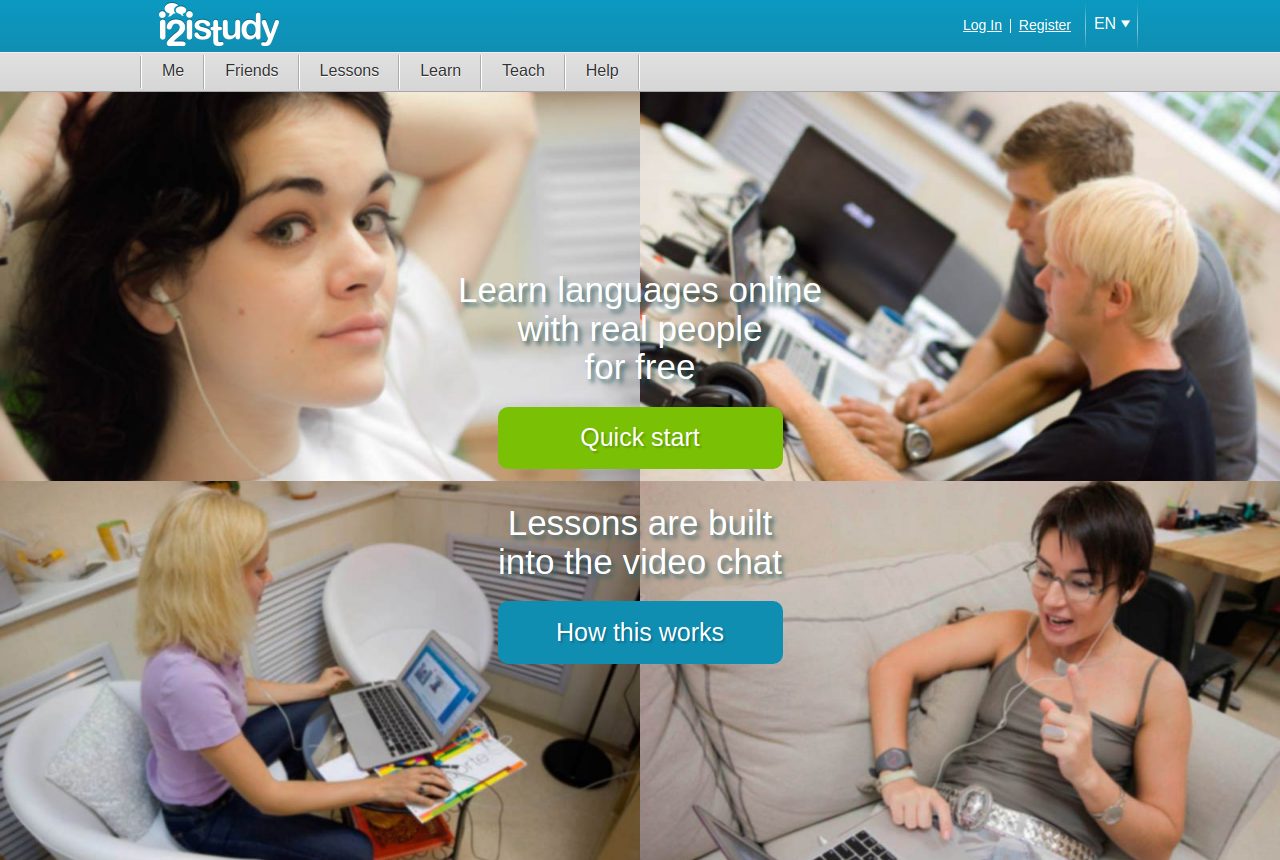 Home page of i2istudy.com
2018 archived copy · web archive
History
Development began in 2012, and the company i2istudy INC. was registered in January 2013.[9] From 2012 the project was a resident of the state institution "Nizhny Novgorod Innovation Business Incubator" (the CLEVER incubator on Larina Street, 22); OOO "AiTuAi-Contact" received resident status together with two other companies following an open competition where the commission had planned to approve only one application, but after the presentations passed all three.[19][13][14] The project's Russian legal entity was OOO "AiTuAi-Contact"; general director — Anna Prasikova; founders — Ilya Osipov and foreign co-investors. In 2013 the project passed selection for the first accelerator of the Internet Initiatives Development Fund (IIDF) — among 50 winners out of 774 applications — and was listed in the cohort as a "crowdsourcing platform for learning foreign languages."[8][15][16] The project passed IIDF's selection but declined the deal: under the fund's terms it would gain veto power — without its consent the company could not change its general director, make a major transaction, or admit new shareholders. Ilya Osipov related this to "Sekret Firmy," and the account of his monologue was published by "Megamozg" in March 2015.[20] That same year i2istudy became a finalist of the X-Lab/BIT competition: as one of ten winners the team traveled to Boston on September 5–17, 2013 (the competition was run by Global Innovation Labs together with MIT MISTI, CRDF Global, the Russian Venture Company, and the RUSNANO department of MIPT); the project was also considered as a potential Skolkovo resident.[17] Nizhny Novgorod television described the idea this way: "It's a social project. In the office, at home, mothers with strollers, students, even pensioners will be able to teach Russian to foreigners."[18] The public beta opened in April 2014; in its first months the service gathered more than 40,000 registered users, with around six thousand people logging in daily.[2]
The platform supported four languages — English, Spanish, German, and Russian — with separate Chinese lessons added later. A new user received 60 minutes of learning time as a gift; further minutes were earned by teaching one's own language, inviting friends, and other actions. This mechanic was covered in March 2015 by the international edtech publication EdTechReview.[7] In a 2018 snapshot of the home page, the service's counter showed 103,084 registered participants.[1]
How the service worked
The main difference between i2istudy and conversational language-exchange services was lessons built directly into the video chat. Both sides saw the same pre-prepared interactive script, so teacher and learner understood each other even without a shared language, and any native speaker could teach without pedagogical training. Time was the internal currency: those who only wanted to learn could pay in the teacher's time, while those who taught could earn it. The ready-made lessons also included pronunciation practice: the learner repeated phrases after the native speaker, who corrected them using the lesson's prompts. Teachers were found by language proficiency, learner reviews, and presence in the system; the authors named the main goal as removing the fear of speaking a foreign language.[1][2]
Academic publications
The platform gained academic recognition: a series of peer-reviewed papers on online learning, gamification, and mutual learning with native speakers was written using i2istudy as its material. The series' co-authors are the project's founders Ilya Osipov and Anna Prasikova, University of South Florida professor Alex Volinsky, and professor Evgeny Nikulchev. The main publications (citation counts per OpenAlex as of August 2026 in parentheses):[11]
- Osipov I. V., Nikulchev E., Volinsky A. A., Prasikova A. Y. Study of Gamification Effectiveness in Online e-Learning Systems // International Journal of Advanced Computer Science and Applications. 2015. Vol. 6, No. 2. DOI: 10.14569/IJACSA.2015.060211 — 79 citations.[10]
- Osipov I. V., Prasikova A. Y., Volinsky A. A. Participant behavior and content of the online foreign languages learning and teaching platform // Computers in Human Behavior. 2015. DOI: 10.1016/j.chb.2015.04.028 — 39 citations.[3]
- Osipov I. V., Volinsky A. A. et al. Gamification, Virality and Retention in Educational Online Platform // International Journal of Advanced Computer Science and Applications. 2015. Vol. 6, No. 4. DOI: 10.14569/IJACSA.2015.060402 — 15 citations.[4]
- Osipov I. V., Volinsky A. A., Prasikova A. Y. E-Learning Collaborative System for Practicing Foreign Languages with Native Speakers // International Journal of Advanced Computer Science and Applications. 2016. Vol. 7, No. 3. DOI: 10.14569/IJACSA.2016.070306 — 8 citations.[5]
- Osipov I. V., Volinsky A. A., Nikulchev E., Prasikova A. Y. Online e-learning application for practicing foreign language skills with native speakers // Technology, Innovation and Education. 2016. Vol. 2, No. 1. DOI: 10.1186/s40660-016-0009-1 — 4 citations.[6]
- Osipov I. V., Volinsky A. A., Prasikova A. Y. Real Time Collaborative Platform for Learning and Teaching Foreign Languages // arXiv:1501.04155. 2015.[2]
Altogether the series has gathered about 145 citations; the most cited is the paper on the effectiveness of gamification in online learning.[11] Ilya Osipov's h-index as a researcher is 6, with 174 citations across all his works.[12] One of the series' conclusions: tightly structured lessons allow successful teaching regardless of the native speaker's pedagogical qualifications.[6]
Gallery
Fate of the domain
The service ran for several years and then ceased operations; Crunchbase lists the company as closed.[9] The last snapshot of the active site in the web archive is dated October 2018. The domain's fate is unusual: the founders kept i2istudy.com for themselves and personally set up a redirect from all pages to the 2018 archived copy of the site in the Wayback Machine — a rare case of a closed site knowingly sending visitors to its own archive (verified by a check in August 2026).[1]
Encyclopedia research: Archival study of the Nizhny Novgorod internet from the counter.nn.ru rating.
Sources
- web.archive.org — Web archive — home page of i2istudy.com, snapshot of October 26, 2018 (archive)
- arxiv.org — I. Osipov, A. Volinsky, A. Prasikova. Real Time Collaborative Platform for Learning and Teaching Foreign Languages (2015) (archive)
- sciencedirect.com — Participant behavior and content of the online foreign languages learning and teaching platform — Computers in Human Behavior (2015)
- thesai.org — Gamification, Virality and Retention in Educational Online Platform — IJACSA, vol. 6, No. 4 (2015) (archive)
- thesai.org — E-Learning Collaborative System for Practicing Foreign Languages with Native Speakers — IJACSA, vol. 7, No. 3 (2016) (archive)
- link.springer.com — Online e-learning application for practicing foreign language skills with native speakers — Technology, Innovation and Education, Springer (2016) (archive)
- edtechreview.in — How i2istudy Makes Foreign Language Learning Easy — EdTechReview, March 20, 2015 (archive)
- habr.com — List of all IIDF projects — IIDF blog on Habr: i2istudy in the first accelerator cohort (archive)
- crunchbase.com — i2istudy INC. — company profile on Crunchbase (founded January 2013; closed)
- doi.org — Study of Gamification Effectiveness in Online e-Learning Systems — IJACSA, vol. 6, No. 2 (2015)
- openalex.org — OpenAlex, an open index of scholarly citations — citation counts for the paper series, August 2026
- semanticscholar.org — Semantic Scholar, author profile of Ilya V. Osipov: h-index and total citation count, August 2026
- FederalPress — "Three new projects to be developed at the Nizhny Novgorod business incubator" (archive)
- web.archive.org — Resident companies of the CLEVER business incubator as of May 2013 (archive)
- web.archive.org — "First IIDF accelerator cohort closed" (archive)
- rbcdaily.ru — RBC Daily on the first IIDF accelerator cohort: 774 applications (2013) (archive)
- bit-konkurs.ru — X-Lab/BIT competition: finalists of the Boston trip, September 2013 (archive)
- nntv.tv — NNTV segment on the i2istudy project (2013) (archive)
- nn.dk.ru — "NIBI Gained Three New Residents" — Delovoy Kvartal (Nizhny Novgorod), 2014
- web.archive.org — "Why i2istudy Chose Not to Work with IIDF" — Megamozg, March 30, 2015 (an account of Ilya Osipov's monologue in "Sekret Firmy") (archive)