
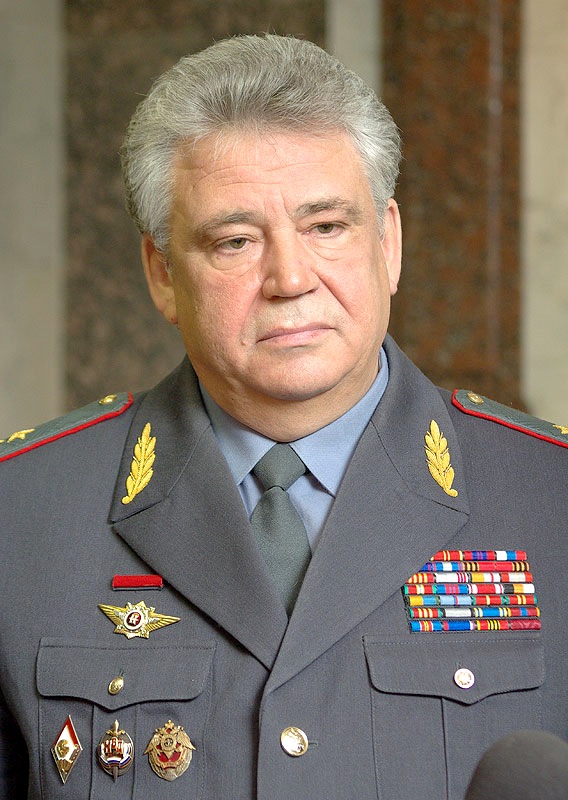
Vyacheslav (Ivanovich) Kanygin, "General Kanygin" — Lieutenant General, former head (rector) of the Nizhny Novgorod Academy of the Ministry of Internal Affairs of the Russian Federation. Former head of the Regional Main Directorate of Internal Affairs.
Candidate of Legal Sciences.
Awarded by Deputy A. Khinstein the commemorative medal "Patriot of Russia" "for personal contribution to the improvement of the system of patriotic education of citizens of our country".
Awarded by A. Khinstein. Laureate of the commemorative medal "Patriot of Russia."
A believer, Russian Orthodox.
Brief biography
Born on October 29, 1949, in the selo of Lomovka, Krasivsky District, Tambov Region. In 1975 he graduated from the Moscow Special Secondary School of the Militia of the USSR MVD; in 1983 from the Academy of the USSR MVD; and in 1999 from the Higher Academic Courses of the Management Academy of the MVD of Russia.
In 1971, V.I. Kanygin entered service in the internal affairs agencies as a militiaman at the 122nd militia precinct in Moscow, and over 11 years rose to become head of the criminal investigation department of the Internal Affairs Directorate of the Kievsky District Executive Committee in Moscow.
In 1982, Vyacheslav Ivanovich transferred to the central apparatus of the MVD. In 1994, serving as chief inspector of the main inspectorate of the MVD of Russia headquarters staff, V.I. Kanygin was appointed Minister of Internal Affairs of the Karachay-Cherkess Republic.
From 1998, Vyacheslav Ivanovich served in Nizhny Novgorod Region — first as deputy head of the Internal Affairs Directorate, and then as head of the Main Directorate of Internal Affairs.
From April 26, 2003, V.I. Kanygin has served as head of the Nizhny Novgorod Academy of the MVD of Russia.
In 2002, Vyacheslav Ivanovich defended his dissertation for the degree of Candidate of Legal Sciences on the topic "Problems of Comprehensive Analysis and Prevention of Crime in the Region (based on materials from the Volga Federal District)." To date, he has published more than 10 scholarly and educational-methodological works, including 2 textbooks.
V.I. Kanygin holds more than 30 state awards, commendation badges, and honorary titles. Among them are: the Order "For Personal Courage," the medals "For Excellence in Maintaining Public Order" and "For Valiant Service," the honorary title "Honored Officer of the Internal Affairs Agencies of the Russian Federation," and the commendation badge "Combat Veteran." He has also been awarded a named firearm.
Interview
Lieutenant General Vyacheslav Kanygin: "When there's a church nearby, the soul feels light" February 15, 2007, 14:08.
On January 28, the rector of the Cathedral of Saint Alexander Nevsky, Archpriest Sergiy Matveev, served a prayer service in the cathedral's icon-painting workshop to mark the start of work on the iconostasis of the Church of Saint George the Victorious at the Nizhny Novgorod Academy of the MVD of Russia.
For four years the academy has been headed by Lieutenant General Vyacheslav Kanygin, at whose initiative the construction of the church was begun. We spoke with him about the challenges and successes of this construction project, as well as about his personal experience of faith.
— Vyacheslav Ivanovich, how did the idea of building a church at the academy come about?
— Frankly, this idea came to me back in childhood — I was drawn to the church from an early age. But I was baptized at 33, and after my baptism I developed a particular desire to live near a church, to hear the ringing of bells, so that my soul might rejoice.
And already during my time as head of the academy, the thought finally matured in me that a church needed to be built. So that our young students — the cadets who study here — could attend it, and not only they, but also the residents of the surrounding area, where there has never been a church, and the patients of the oncology hospital located not far from us. After all, just our cadets number two thousand here — two nine-story dormitories — and think how many more people could come to our church and cleanse their souls, leave it as new people!
When there's a church nearby, the soul becomes light and joyful, one feels like working and smiling. So, I had this thought for a long time, and finally, with God's help — and only with it, there can be no question about that — I turned to Archbishop Georgy for advice. He replied: let's think it over; it's easy to say "build a church," but to bring it to life is very hard.
— And the hardest part, probably, turned out to be the financial question?
— Of course. Especially since the church is being built not from the academy's funds but from private donations — from cadets, teachers, and other citizens whom I approach. It is hard. I thought things would move much faster. In May it will be two years since, with the blessing of Patriarch of Moscow and All Russia Alexius II, Archbishop Georgy and I laid the cornerstone and decided that it should be dedicated to Saint George the Victorious — the patron of the Orthodox military — and on May 6 we are to consecrate it.
During the construction process I encountered difficulties I had not anticipated, but God helps everywhere. For instance, there is absolutely no money, and suddenly cadets come to me and say: "Vyacheslav Ivanovich, we want to donate part of our stipend" — and we gather exactly the sum that is needed. And I understand: the Lord has opened their eyes.
They voluntarily write applications for donations — whoever wishes, there is no coercion here at all. They understand that this church is being built for them, that they can come to it at any time of day or night to ask God for help — to pass exams, for instance — to be baptized and married, because a permanent priest will be assigned to the church. People from outside also come and say they want to donate eighteenth-century icons to the church. Who compelled or directed them?
— People of your profession find it hard to survive without hope in God and the sense of His help…
— About ten years ago, when I was head of the Main Directorate of Internal Affairs of Nizhny Novgorod Region, I was checking posts around the city at two in the morning. I was driving along Belinka past the Church of the Savior, and I see: a cadet standing at attention in front of the church, asking God for something, praying. It struck me so deeply! What was he asking for — health for his parents, or for himself? And I decided: a church must be built.
In general, I have had many such profound moments in my life. I fought, spent a long time in Chechnya and in all the hot spots of the former Soviet Union, was wounded, but with God's help I always remained alive. That is why I believe that building a church at institutions like ours is simply necessary. The more churches there are, the kinder people will be.
— Are many of your donors police officers?
— No, the majority of them have no connection to the militia whatsoever, but their names will be listed on a special plaque to be hung in the church so that the parishioners may know their benefactors. There are no prominent figures among them; they are ordinary citizens, without rank or title. Some bring five thousand rubles, some ten thousand — every little helps. There are even donors from other cities, for instance those whose children once graduated from our academy. There are heads of district administrations as well — for example, Batsin Viktor Ivanovich, head of Pochinkovskiy District, whose son once graduated from our academy.
Currently many people come to me and choose icons for the iconostasis that they wish to fund. I think that following the old custom, one could inscribe on the icon the name of the person who donated funds for it. As for me, God Himself has directed me to donate the icon of the holy martyr Vyacheslav of Bohemia.
— Is the church nearly finished now?
— Yes, 99%. Only the iconostasis and the interior furnishings remain, but the clergy will take care of those. At the end of February I will travel to Sofrino in Moscow Region to choose church vessels and utensils. I have already purchased the oil lamps, and in general one million rubles of private donations will be spent on the furnishings. In the summer, after the consecration of the church, a bell tower will be built, for which we have already ordered four bells of different sizes.
— Your cooperation with the diocese has long-standing traditions…
— Archbishop Georgy helps us greatly, always takes an interest in our affairs, gives good advice. How many churches have been built and restored under him! Our academy has signed a cooperation agreement with the diocese. The Archbishop always comes to the ceremony for the awarding of a cadet's first rank of junior lieutenant of the militia, and to the oath-taking ceremony, which happens only once in a cadet's life — parents come from all corners of the country for it.
A cadet takes an oath of loyalty to the Motherland and the people, and the Archbishop also gives his blessing — this stays with you for life, it obliges one to be a true patriot.
We are now working out arrangements for meetings between seminary students and our cadets. Once a week, representatives of the diocese will come to give us lectures on the harm of sects. For all major church celebrations we send cadets and provide equipment, rendering the diocese any assistance — we have very close and friendly relations. The Archbishop's participation in our events is simply necessary — for the enlightenment of the soul, for the upbringing of a new generation of patriots of Russia.
— Vyacheslav Ivanovich, are there believers in your family?
— My father lived a very long and good life — 96 years. In his youth he was a bell-ringer for two years — in 1915–16 — fought in all the wars: the Finnish, the Patriotic War, was seriously wounded and shell-shocked, then for 40 years was a school principal, and was never a party member.
He used to say to me: "Son, when you climb up into the bell tower and begin to ring, the heart rejoices!" And when we walked together down the street and the bells suddenly began to ring, he would cross himself every single time. How he managed, in years of harsh ideological pressure, to remain non-partisan in such a position and to profess his faith publicly — it is simply a mystery.
Svetlana VYSOTSKAYA, website of the Nizhny Novgorod Diocese of the Russian Orthodox Church nne.ru
Notable statements
"Tomin is to our academy what Lomonosov was to Moscow University," said the head of the Nizhny Novgorod Academy of the MVD, Lieutenant General of the Militia Vyacheslav Kanygin, opening a session of the academic council dedicated to the 50th anniversary of the Nizhny Novgorod procedural school.
The founder and patriarch of the scholarly community that has united specialists in the field of procedural law is rightly considered to be Doctor of Legal Sciences, Professor of the Department of Criminal Procedure and Criminalistics at Lobachevsky University, and Professor of the Department of Criminal Procedure at the Nizhny Novgorod Academy of the MVD of Russia, Valentin Tomin. On the occasion of the 50th anniversary of his scholarly career, this Honored Scientist of Russia, member of the coordinating council of the International Union of Jurists, Vice-President of the Union of Jurists of Russia, and so forth, received from the hands of the academy's head yet another award — the medal of the International Association of Police Officers, 1st degree.
— The main thing is to have students, so that one has someone to learn from, — said the teacher in his address to the academic council. He has trained dozens of doctors and candidates of sciences, scholars in the field of criminal procedure who are known throughout Russia.
Professor Tomin has an interesting life story — he worked his way up from an ordinary investigator to a renowned scholar with more than fifty books to his name. His non-fiction book "Kill the President," for example, was a great success with readers who have no connection to jurisprudence or to scholarship in general.
Honoring their teacher and colleague, the participants of the gathering decided to declare November 7 the official birthday of the Nizhny Novgorod Procedural School. Conveniently, in the new calendar this date has recently been free of public holidays.
"Nizhegorodskie Novosti." A procedural jubilee November 9, 2007. Tatyana CHINYAKOVA.
Criticism
.. Ivan Petrovich Sklyarov and Kanygin masterfully honed the art of public relations and self-promotion, exploiting the "horrors" of the Chechen war. Consider, for example, the following triumphant dispatch, widely circulated in the Mass Media, which is worth quoting verbatim:
"Yesterday, Nizhny Novgorod Region Governor Ivan Sklyarov was due to travel to Chechnya with a humanitarian cargo. However, at the last moment he called off the trip, and the group was led instead by the head of the Region's Main Department of Internal Affairs, Lieutenant General Vyacheslav Kanygin. He was the one who fell into an ambush near Gudermes.
Mr. Kanygin and a group of EMERCOM staff were delivering textbooks in the Chechen language as gifts for children — printed by the Nizhny Novgorod printing company Nizhpoligraf. Vyacheslav Kanygin was unharmed, and the EMERCOM personnel of Nizhny Novgorod Region suffered no serious injuries either.
Nevertheless, Mr. Kanygin described the situation in which the Nizhny Novgorod residents found themselves near Gudermes as extremely serious.
"We barely fought our way out," he told Governor Ivan Petrovich Sklyarov. Meanwhile, a source close to Mr. Sklyarov stated that "this time they were lying in wait specifically for the Governor."
<..>
Another scandal involving Kanygin defies any rational explanation. Recently, in the course of a criminal case brought by the military prosecutor's office of the Nizhny Novgorod Garrison against Colonel Anatoly Kazimirov, first deputy chief of staff of the Volga District of Internal Troops, it emerged that the head of the Nizhny Novgorod militia had been handing out official police identification documents to anyone he pleased.
"250 militia officer ID cards bearing the signature of Nizhny Novgorod GUVD chief Vyacheslav Kanygin are in the hands of people with no connection whatsoever to law enforcement agencies," — RIA Novosti reported|author="Federal Investigations Agency", FLB.ru.