The Volga, Itil, Idel, Yul, Atal, Ra ("River of Rivers") — the longest river in Europe. Length approximately 3,530 km.
For Russia, the Volga is one of the country's most important waterways. It connects the north-west of European Russia with the Caspian Sea and Central Asia.
It is a typical lowland river: over its entire course it descends only 256 m in elevation. The Volga rises in the Valdai Hills at an altitude of 228 m above sea level and empties into the Caspian Sea at 28 m below sea level. The Volga is also the largest river of internal drainage — it does not flow into the world's oceans. The river itself, however, has around 150,000 major and minor tributaries draining a basin of 1.36 million km².
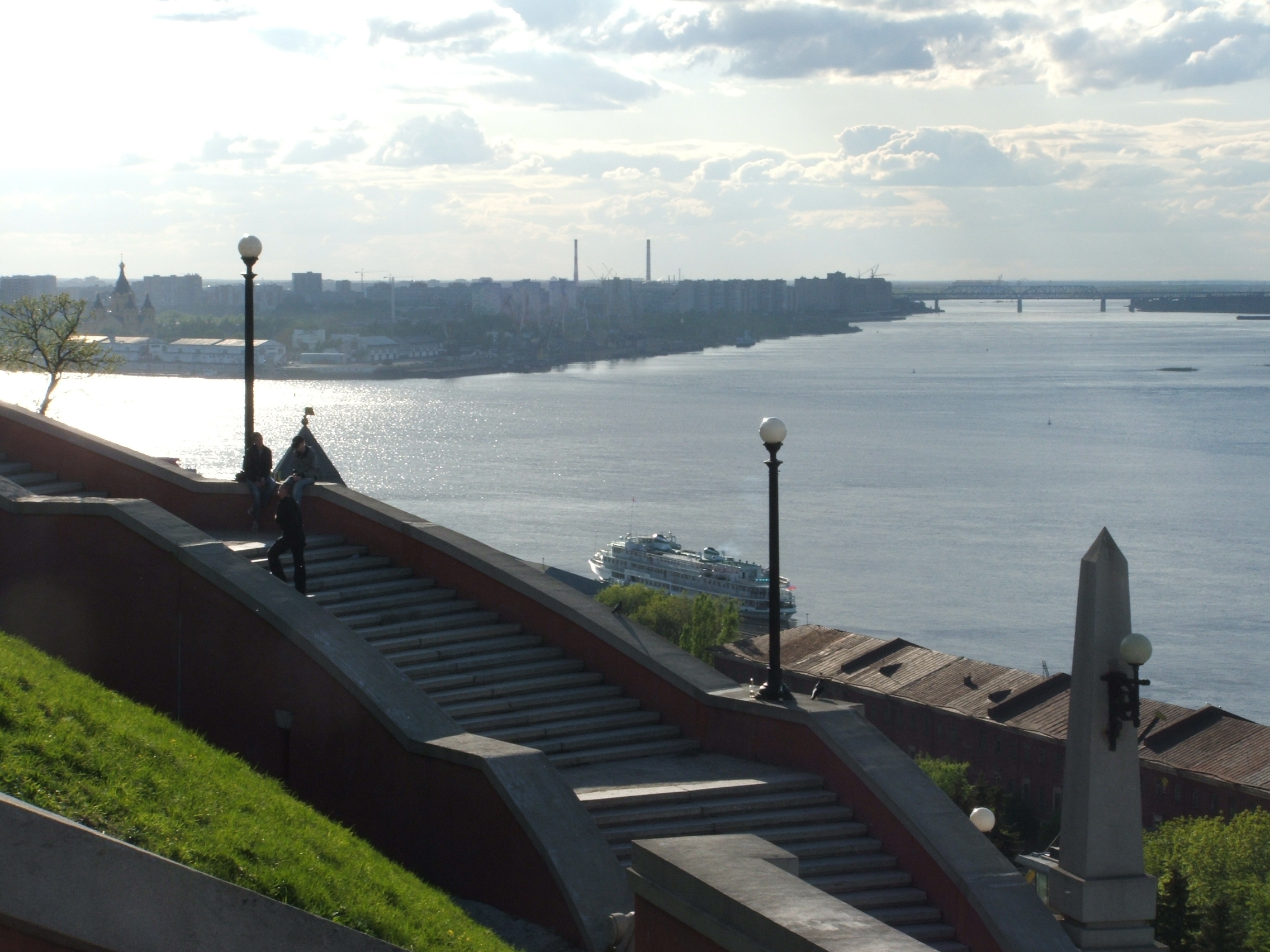
Nizhny Novgorod is one of the largest cities on the Volga and its most ancientCapital Status".
Name of the river
From far away the river flows for a long time… Itil, Idel, Atal, and finally Ra — so the peoples of the world called the great Russian Volga over the course of many centuries.
Ra comes from the "Geography" of Pliny. The ancient Egyptians, Greeks, and Slavs, living before the Common Era, believed that the Volga was the embodiment of the Sun god, and that the sacred land of prosperity, Iriy — or simply, Paradise — lay along its course.
Idel and Yul was what the Tatars and the Mari called the mother river. Atal was the Chuvash name. And the Russian Volga, according to one theory, derived from the Baltic word "valka," meaning "a flowing stream, a marshy place." Considering where the main river of Russia has its source, this theory seems quite plausible. It also explains why, at the same time, the river was called Volga in its upper reaches, while the Turkic peoples living further downstream, who had no knowledge of the Volga's headwaters, called it Itil ("The Endless River, River of Rivers").
Folk beliefs
In all ages, the peoples of the Volga wove legends about their great provider. Some said that you could sail along it all the way to the Sun; others, that it was a road into eternity; still others feared its guardians — the mysterious inhabitants of submerged Volga caves.
Yet in one belief the various peoples agree: the Volga is a protector, the Volga is an intercessor. From the river's current, from the color of its water, our ancestors read the past and the future. The Volga of today is not merely an enormous navigable "blue ribbon" — it is an inexhaustible source of knowledge, both manifest and still hidden, a true historical "book" that one simply needs to know how to read.
About the river
The Volga is a living organism. Every day, every year, every century it is new. To grasp its soul — and thereby the soul of Russia itself, whose name derives from the name of the Ra-river (the land of Raseya) — one must go to its headwaters. There the river will reveal its secret corners and show ancient settlements and age-old sanctuaries, from the Iriy garden to the settlements and sacred places now hidden beneath the water. In the Upper Volga towns, a documentary chronicle of the modern Volga's formation unfolds. Not only museum and archival exhibits, but the people themselves — and the stories, beliefs, legends, and other folklore they share — will bring the Volga closer. It will cease to be merely water; it will become something native and comprehensible. You will want to return to it; you will want to speak with it…
Shallows
After the Volga was transformed into a cascade of not-very-free-flowing lakes, some riverine stretches have nonetheless survived along its course, and these even contain shallows that impede large-vessel navigation. The most well-known of these are the stretch from Gorodets to Balakhna and the Volga-Akhtuba floodplain. In the floodplain, the most problematic obstacles to navigation are the Saralyevsky water junction and the Solodnikovsky shallow.
In June 2012, a half-laden passenger vessel ran aground on the Nizhne-Saralyevsky shallow.
The Volga in culture

|
… the banks of the Volga move slowly toward you — the left bank, bathed in sunlight, stretches away to the edge of the sky like a lush green carpet, while the right bank has thrown its wooded bluffs up toward the heavens and stands motionless in stern repose. Between them the broad-breasted river spreads out majestically; its waters flow silently, solemnly, unhurriedly… | 
|
The Volga has been an inspiration to many writers, poets, and artists. Numerous poems and songs have been dedicated to the great river. Many paintings have been created depicting its magnificent landscapes.
|
|
To look from Nizhny, from the great hill, At the provider Volga, mother river, How in yellow sands, in green meadows She embraced her sister, the Oka from the opera "The Enchantress" by P. I. Tchaikovsky
|
|