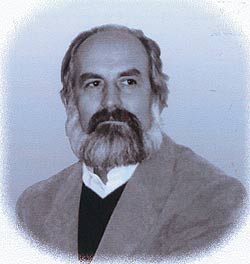
Vladimir (Ivanovich) Zanoga — a contemporary Nizhny Novgorod painter who creates vivid and heartfelt works on spiritual and patriotic themes.
The Nature of the Phenomenon
The central theme of Vladimir Ivanovich's work today is the revival of historical memory in the modern person and a return to the roots of spiritual culture. The artist turns most frequently to Christian motifs. Themes of the Homeland, the continuity of generations, and the restoration of historical memory also run consistently through his landscapes and still lifes.
Biography
Born on 10 July 1953 into a military family. Since 1959 he has lived in Nizhny Novgorod. In 1973 he graduated from the Gorky Art School. After military service (1973–75) he returned to artistic work. He participated in regional, zonal, and republic-wide exhibitions. Several solo exhibitions of Vladimir Zanoga's work were also organized. In 1994 V. I. Zanoga joined the Union of Artists of Russia.
The artist's works are held in the collections of the Nizhny Novgorod Diocese Administration, the Blagoveschenskiy Muzhskoy and Makaryev monasteries, the Nizhny Novgorod Academic Opera and Ballet Theatre, numerous organizations in the city and region, and in private collections belonging to members of the academic and creative intelligentsia in Russia and abroad.
Titles
- Member of the Union of Artists of Russia
- Professor of the International Slavic Academy
In the Press

|
"The Chime of Heaven" — that is what Nizhny Novgorod painter Vladimir ZANOGA named his anniversary exhibition. And indeed, a lofty celestial light permeated the entire display; if painting could produce sound, the halls of the exhibition complex would have rung with the mellow peal of bells. Vladimir Zanoga is a religious artist, both by faith and by conviction. The road to God was a long one, rooted in the youthful years of art school and the army, overcoming the gaudy temptations of a bohemian youth, growing stronger toward creative maturity and extending into the distant reaches of old age — for the path of spiritual perfection and service is boundless. It naturally tolerates not the slightest self-interest, let alone crude opportunism; only love and spiritual purity hold out the promise of genuine creative achievement. Fortunately, those achievements are plain to see, as the exhibition of this fifty-year-old master eloquently confirmed, and we rejoice for him doubly: Vladimir walks a straight creative path, is widely known and in demand — a great rarity in these arduous times.
And yet he started from absolute zero! The son of a career soldier, born at some remote southern border post somewhere on the frontier with Iran or Turkey, he had no idea that Art even existed. From childhood he was surrounded by the austere world of the military: sparse pleasures, scorched landscapes of sand and stone, and for treasured toys — spent cartridge cases and snakes… After his parents moved to Gorky, the boy discovered drawing. By his own recollection, he had no proper paper in those days and had to draw in the margins of newspapers; but the harder things were, the more powerfully the new pursuit gripped him. Then one day his elder sister, a singer, took the boy to the fine-arts studio at the Lenin Palace of Culture. The future artist had entered the temple of Art! The large, bright rooms with high ceilings, old paintings in gilded frames, sculptures unlike anything he had seen before, and above all the engrossing classes in visual art and conversations about great painters and immortal works — it all made his head spin. Vladimir Zanoga will carry gratitude to his first teacher, A. I. Markeyev, for the rest of his life; the memory of him will not be eclipsed by the instructors of the Gorky Art School, where he studied later — though both G. P. Mironova and Kim Ivanovich Shikhov gave incomparably more… From his art-school days Vladimir Zanoga was captivated by the Russian icon. Beyond its absolute formal perfection, honed over centuries, what struck him was the keen sense of antiquity, the mystical connection with forebears and with eternity. The spiritual seed thus planted took root slowly: ten years after graduation, in the 1980s, a cherished painterly series was born — one that united the visible and the invisible: plein-air views combined with icon-like images of the Saviour, the Mother of God, Saint George the Victorious, and radiant angels guarding our earthly existence and standing watch against the dark forces of the cosmos. There is always a great deal of sky in Vladimir Zanoga's canvases, and not by chance: it is the symbol of eternity and the spiritual principle of the universe. "The master's work," art critic Elena Pukhova rightly observes, "is a reminder that Jesus Christ is with us today, that Saint George stands in defence of the Russian land, that the veil of the Most Holy Mother of God is still spread over us." Such is the inspired power of faith that even in times as troubled and in many ways fateful as these, it instils a lofty assurance and firm conviction in our great purpose on earth. In the broadest sense, this is precisely the meaning of true Art, and when It is touched by faith, its works are destined for eternity…"Nizhegorodsky Predprinimatel", 2003/8, Pavel Klimeshov
|

|
|
|
Vladimir's childhood was spent at a remote border post where his father was stationed. For as long as he could remember, he drew — in the margins of newspaper pages, on any scrap of paper.
When the family moved to Gorky, his elder sister, who had also drawn since childhood, took him to the fine-arts studio at the Lenin Palace of Culture. The future artist had entered a temple of art. Spacious, bright rooms, paintings and sculptures, and above all the passion for drawing, an introduction to the works of great painters, and the first lessons in painting from the studio director, Alexander Ivanovich Markeyev — Vladimir would remember him with immense gratitude for the rest of his life. Then came art school, the army, marriage to his fellow student Nina Zhdanova, the birth of two daughters (one of whom is now also an artist), and an endless, unquenchable thirst for creative work. The life of the spirit is paramount for this artist. His natural landscapes, suffused with warmth and love, reveal to the viewer the full breadth and diversity of Russia. More than 150 canvases in the exhibition were painted by the artist over the past three years during creative voyages along the Volga and the Kama in 2007, to the Russian North as far as the Solovetsky Islands in 2008, and that summer along the Volga to Astrakhan. All these journeys were made aboard the cruising yacht Nefertiti and the sailing catamaran Martin, undertaken in order to see with his own eyes the beauty of the villages, selos, and towns created by our ancestors and contemporaries along the rivers that have always been the roads of Russia. The colour of the sky and the splash of waves, the torn songs of the wind and the ringing of bells — he transferred all of this to his canvases. Sometimes, sailing past breathtaking places of indescribable beauty in a strong wind, Vladimir Ivanovich would beg the captain, Mikhail Khramov, to drop anchor and give him a chance to paint a study — to which he would regularly receive the same reply: "I want you to stay alive!" Yet he nonetheless managed to capture so many vivid landscapes that, looking at the river, one sometimes wants to say: "It's just like a Zanoga." His "children-creations," as Zanoga calls his paintings, demand a life and biography of their own. The impact of a painted canvas is instantaneous. The artist wanted the poetic lines that came to him during work to help viewers understand the painting better. That is how the first poems appeared — "author's annotations," as Vladimir Ivanovich calls them. Today such annotations accompany nearly all his works. Completing its long journey through the ages, The river's song is born again, How beautiful the image of the young Volga, Having gathered streams and the Oka's might. (For the painting "The Volga. An Allegory") Everything is called upon aboard a sailing vessel: knowledge of seamanship and navigation, skill in mooring, the ability to work in the galley, to catch fish, to play guitar and sing. But most important of all is the ability to live together as a crew during a long voyage along the river. Returning to one's native haunts sharpens and deepens one's perspective on all that was seen and experienced during the wanderings, and helps one feel anew the warmth and intimacy of the familiar landscape of home. Let us return to autumn, to the colour of sunset, Enriched by fate. Friends, sketches, photographs, dates — All of this is my baggage and yours. Vladimir Ivanovich met his future wife at art school. But they did not marry straight away. After graduating he served two years in the army, while she continued her studies at the renowned Stroganov School in Moscow. Nina Ivanovna began drawing early, but she was more drawn to fairy-tale allegorical subjects. Among her childhood works is a self-portrait painted in front of a mirror, a snow-covered village, characters from books she had read, and even images seen in dreams. She too, after a year's study at the fine-arts studio of the Lenin Palace of Culture, firmly decided to become an artist. Nina Ivanovna's path to watercolour was a lifelong one. First came tapestries, macramé, decorative art, oil, gouache, and interior design. In the early 1990s the artist became captivated by the watercolour technique of alla prima — painting on wet paper. It is a kind of shorthand on a wet surface. Such a picture must be completed in a single sitting, in three or four hours, before the paper dries. But it is precisely this technique that makes it possible to convey the freshness of impressions, the moment-to-moment changes in nature, the vibrancy of colour tones, the delicacy and perfection of forms, and the artist's love for the surrounding world. The grey herons living on Lukovo Lake opposite Vasilsursk, bright floral motifs, and austere, majestic churches are the principal themes of the artist's most recent paintings. Nina Zhdanova's watercolours are extraordinarily sincere, spontaneous, and lyrical. And just like Vladimir Ivanovich, his wife accompanies them with poetic commentaries. The moon has risen into the heavens, Stop and be still. Look, how beautiful Makariy is In the ultramarine night. (For the painting "The Light of Makariy") The artists' daughter Masha Zanoga has, as one might expect, inherited her parents' talent. Five of her works are on display at the exhibition of young artists in the Exhibition Hall on Minin Square in Nizhny Novgorod. The number of people who have caught the art bug through contact with Vladimir Zanoga keeps growing. Recently I learned that first mate Vyacheslav Kostin, who had travelled with him aboard the sailing catamaran Martin... had already bought paints. |
|
Notable Quotes
|
|
The most precious gifts for me were the ones from children: drawings they made themselves — charming, sometimes funny, but above all sincere and candid, with inscriptions also written in a childlike way, yet always with some kind of love, some good feeling — it's touching somehow. Now my granddaughter is growing up and gives me her drawings made the same way. Gifts from adults tend to be more formal. Children's drawings are somehow phenomenal; then a certain period passes and they can never draw like that again. |
|
Interesting Facts
- Patriarch of Moscow and All Russia Alexy II decorated his office with one of Vladimir Zanoga's works.