
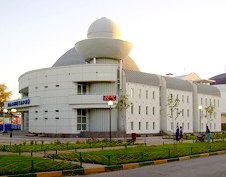
Nizhny Novgorod Planetarium — an educational and entertainment center for displaying the starry sky and cosmic objects. As of 2007, the most advanced planetarium in Russia.
The Essence of the Phenomenon
A small unitary enterprise on the balance sheet of the city administration. Motto: "The Universe will come closer".
From the opening of the 1948 school season until December 5, 2005, the planetarium was housed in the building of the Alekseyevskaya Church of the Blagoveshchensk Men's Monastery.
The renovated planetarium in Nizhny Novgorod became an exhibition venue equipped with the most advanced digital projectors and lecture halls. Concerts, conferences, and presentations of various large-scale innovative projects are held here.
In 1993, the Nizhny Novgorod Planetarium took the initiative to establish the Association of Planetariums of Russia.
Since 1994 it has represented Russian "star houses" in the International Planetarium Society, and in 1998 was recognized as the organizational and methodological center of planetariums of the Russian Federation.
History of the Matter
Opening
It began operations on September 1, 1948, becoming the second planetarium in the USSR after the Moscow one, which opened in 1929.
Resolution on the Opening of the Planetarium

|
RESOLUTION No. 957
Of the Executive Committee of the Gorky City Council of Workers' Deputies, September 23, 1947. "On the organization of an educational planetarium in the city of Gorky." In accordance with the directive of the Council of Ministers of the RSFSR dated August 28, 1947, No. 2053-r THE EXECUTIVE COMMITTEE OF THE CITY COUNCIL RESOLVED: To organize in the city of Gorky an Educational Planetarium in the premises currently occupied by the warehouse of the Oblshveyremsoyuz. To require Oblshveyremsoyuz to vacate the premises used as a warehouse within five days. To require the Department of Cultural and Educational Work (Comrade Guryeva) and Torgstroy (Comrade Smirnov) to begin renovation of the premises from September 25, 1947, and to open the planetarium therein no later than November 6. To authorize the Department of Cultural and Educational Work to spend 250,000 rubles from the city budget on the purchase of equipment and on the renovation and fitting-out of the planetarium. To require the head of the City Finance Department, Comrade Alekseyev, to finance the Department of Cultural and Educational Work in the amount of 250,000 rubles by reducing expenditure on non-limit costs for the construction of the A.M. Gorky monument. To approve the staffing schedule submitted by the Department of Cultural and Educational Work. To request the Council of Ministers of the RSFSR to petition the State Staffing Commission under the Council of Ministers of the USSR for approval of the staffing schedule for the educational planetarium. To instruct the Department of Cultural and Educational Work to submit to the Executive Committee of the City Council a work plan for the Gorky Educational Planetarium by October 15 of the current year. To assign oversight of the vacating of the premises to the City Housing Administration, Comrade Ignatyev. Chairman of the Executive Committee of the City Council of Workers' Deputies (Shulpin) Secretary of the Executive Committee of the City Council of Workers' Deputies (Snegirev) |

|
Original Equipment
Originally, a UP-2 star projector ("simplified planetarium," second model), manufactured in the workshops of the Moscow Planetarium, was installed in the center of the Star Hall.
In 1974 it was replaced by a "ZKP-1" projector made by the German firm Zeiss, and in 1991 by a "SKYMASTER-ZKP-2," which projects images of 5,800 stars down to the 6th stellar magnitude. Each of the two large star globes contains a 50-watt lamp that projects stars of the northern and southern hemispheres respectively through 32 specialized projectors. The "SKYMASTER" is a third-generation instrument from Carl Zeiss. It belongs to the small-type planetarium category and projects celestial bodies onto a dome screen 8 meters in diameter. The seating capacity of the auditorium is approximately 80 people.
New Building — New Technologies
After the building was returned to the Russian Orthodox Church, a decision was made to construct a new planetarium. The planetarium did not suspend its operations during construction.
On February 4, 2005, a competitive selection of organizations was held for the right to construct the Nizhny Novgorod Planetarium.
The winner of the open competition was Nizhny Novgorodstroymontazh LLC. Construction began in May. The new building was erected in four months. Work at the construction site proceeded in three shifts. The builders worked with extraordinary enthusiasm.
On October 4, the day the first artificial Earth satellite was launched, the most complex phase of the construction work was successfully completed — the lifting and installation of the dome roof. In mid-October the construction of the building was finished. Interior finishing work is now under way. The facility is being commissioned in two stages: the first launch complex was commissioned in 2005, and the second will be commissioned in 2006. The first launch complex allows the astro-classroom "Planets," the "Astronomy" hall with a small five-meter training dome, the multimedia museum hall "Cosmonautics," a specialized scientific library, the scientific and methodological department, the engineering and technical service, administrative premises and service staff facilities, a café-bar, a shop, restrooms, and a cloakroom for visitors to begin operation.
Due to insufficient funding and the complexity of the engineering solutions, work on the second Star Hall with a 16-meter dome and an open astronomical observatory has been deferred to the second stage. On December 5, 2005, the Nizhny Novgorod Planetarium ceased operations in its old building. But as early as December 14, the first event was held in the new building — the traditional monthly oral journal "We and the Universe" — and on December 21, lectures began.
The latest technologies were employed in the construction of the new planetarium; moreover, it surpassed the old building and is ready to accommodate more than 50,000 visitors annually and to hold 1,300 events. The planetarium complex includes the multimedia halls "Planet" and "Cosmonautics."
The first "digital planetarium" system in Russia was installed at the planetarium. Of the approximately 4,000 planetariums existing worldwide, such a system has been installed in only around 200.
Design and Equipment
The image on the dome of the Nizhny Novgorod Planetarium is created by 6 digital projectors arranged in a circle and controlled by a central computer.
The "digital planetarium" has undeniable advantages — the dome can display not only stars but also video footage and a wide variety of phenomena, including fantastical ones, such as simulated flights to other planets, stars, and so on.
The majority of sessions consist not of a traditional lecture format but of a pre-recorded film, typically with high-quality narration and a carefully developed script.
The system also has a few minor drawbacks, apparently due to imperfections in the technology:
- insufficiently dark sky;
- noticeable flickering of stars when transitioning across pixels.
Departmental Affiliation
Over the half-century history of the Nizhny Novgorod Planetarium, its supervising bodies changed several times. Initially the planetarium was under the jurisdiction of the City Department of Cultural and Educational Work, then the Regional Society "Znanie" (from 1961 to 1992), the Regional Department of Education and Science (1992–1997), and finally, in 1997, the planetarium was transferred to the jurisdiction of the Department of Culture of the Administration of Nizhny Novgorod.
Cooperation. International Ties
The Nizhny Novgorod Planetarium works closely with the Nizhny Novgorod Circle of Physics and Astronomy Enthusiasts, the Euro-Asian Astronomical Society, the Astronomical Society of the Pacific, the Association of Planetariums of Ukraine, and other organizations with scientific and educational profiles.
For its outreach and educational activities, the Planetarium engages highly qualified specialists from the Institute of Applied Physics of the Russian Academy of Sciences, the Radiophysical Research Institute (NIRFI), the Nizhny Novgorod Pedagogical University named after Gorky, Nizhny Novgorod State University named after N.I. Lobachevsky, the Moscow Aviation Institute, the Yuri Gagarin Cosmonaut Training Center, the Sternberg State Astronomical Institute (Moscow State University), and others.
Interesting Facts
- The planetarium in Nizhny Novgorod was the second planetarium to open in the USSR.
- The opening of the Grand Star Hall of the Nizhny Novgorod Planetarium was timed to coincide with the 50th anniversary of the Space Age and took place on October 4, 2007.
- At the end of 2007, the country's only space docking simulator was installed at the planetarium, allowing the docking of spacecraft to be carried out. The simulator is designed for manual approach, docking, and redocking of the Russian crewed spacecraft Soyuz-TMA to various ports of the International Space Station. The device was created with the participation of specialists from the Russian Center for Simulator Engineering.
- Honorary members of the Nizhny Novgorod Planetarium staff include: Professor and Deputy Director of the Institute of Applied Physics of the Russian Academy of Sciences Ya.I. Khanin; pilot-cosmonaut and twice Hero of the USSR G.M. Grechko; Professor at the Moscow Aviation Institute and academician of the K.E. Tsiolkovsky Academy of Cosmonautics G.A. Poltavets; cosmonaut-researcher V.L. Ponomareva; and cosmonaut-tester, Doctor of Technical Sciences, Professor M.N. Burdayev.
Contacts
Municipal Cultural Institution "Nizhny Novgorod Planetarium," Russia, 603002, Nizhny Novgorod, Revolyutsionnaya Street, 20, tel.: (831) 246-77-89, (831) 246-70-65.
Call 272-50-94 on weekdays (from 10:00 to 17:00) to reserve tickets for any session. Tickets must be picked up one hour before the session begins.
Latest Programme for the Upcoming Weekend
Nizhny Novgorod Planetarium programme