
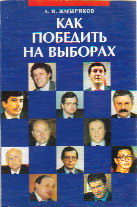
Nizhny Novgorod Psychotechnology — a political technique for exerting covert influence, developed by scientists in Nizhny Novgorod.
An article shedding light on its characteristics was first published on the official website of the "Institute for Social and Political Problems" on December 3, 2002:

|
The mind's secret weapon...
A three-day training seminar for political strategists was held in Nizhny Novgorod. Representatives from the five federal districts were introduced to a new technology for indirectly managing the behavior of large groups of people. At the end of the seminar, I was able to interview one of our Gorod’s guests, Professor Nikolai Petrovich Fetiskin. – Reporter: Nikolai Petrovich, how do you explain the fact that the training seminar was held in Nizhny Novgorod, rather than, say, in Moscow or Saint Petersburg? – N.F.: Of course, it’s an absolute priority for your political strategists. Professionals know that socio-psychological techniques for managing people’s political behavior have a long history. According to some sources, the origins of this history can be traced back to the 4th century B.C. However, when it comes to techniques in the modern sense of the word, it was not the Americans or the French who pioneered them, but your Gorky-based political scientist, Professor Vladilen Yakovlevich Izraitel. It was he who not only provided a theoretical foundation for innovative approaches to managing political processes, but also succeeded in putting these ideas into practice for the first time. In the 1990s, his innovative political center, “Pragma,” was the stuff of legend. Fortunately While Vladilen Yakovlevich—this “Mozart” of modern psychotechnologies—was still living in Gorky, a “Salieri” emerged: the now-famous professor The Salieri of Nizhny Novgorod. In the creative clash between two completely different schools of thought, the “shield and sword” of technological approaches to influencing political processes were forged. This clash bore remarkable fruit not only in specific theories and the concrete successes of politicians, but also in the emergence of prominent representatives of both schools. In Izraitel’s school, these representatives were Vladimir Konstantinovich Spitsyn and Alexander Nikolaevich Zhmyrikov. In Kolobov’s school, they were Boris Samuilovich Dukhan and Andrei Stanislavovich Makarychev. – Reporter: Nikolai Petrovich, as far as I know, at your seminar, political strategists were learning some unique method of influencing people’s minds, which they called “the JAN effect". Is there a simpler way to explain this secret weapon of the mind? – N.F.: First of all, let’s clarify the terms. A few years ago, Zhmyrikov) put forward a hypothesis regarding a paradoxical shift in voters’ sociopolitical attitudes when perceiving Chinese characters arranged in a specific spatial pattern. The paradox lay in the fact that the direction of the change in attitude differed significantly from that observed by Gestalt psychologists in their classic experiments of the 1930s. At first, no one in the world took the hypothesis seriously. The authority of the classics of Gestalt psychology weighed too heavily. However, during a natural experiment (an election campaign), Alexander Nikolaevich managed not only to actually record the results of a change in attitude but also, using the proposed model, to artificially alter them himself in the desired direction, people began talking about the “ZHAN effect.” Subsequently, many social psychologists, including myself, were able to test the model proposed by the author and confirm its effectiveness. Subsequently, Alexander Nikolaevich Zhmyrikov, in collaboration with colleagues from Saint Petersburg and Yaroslavl, developed an innovative methodology for managing the process of shaping electoral attitudes in a society undergoing transition. This technology does not yet have an official name. It is referred to as whether it be the "hieroglyphic marking" technique, the technique of dual-mediated control of the process of behavioral conditioning, or simply "Nizhny Novgorod Psychotechnology". |

|