
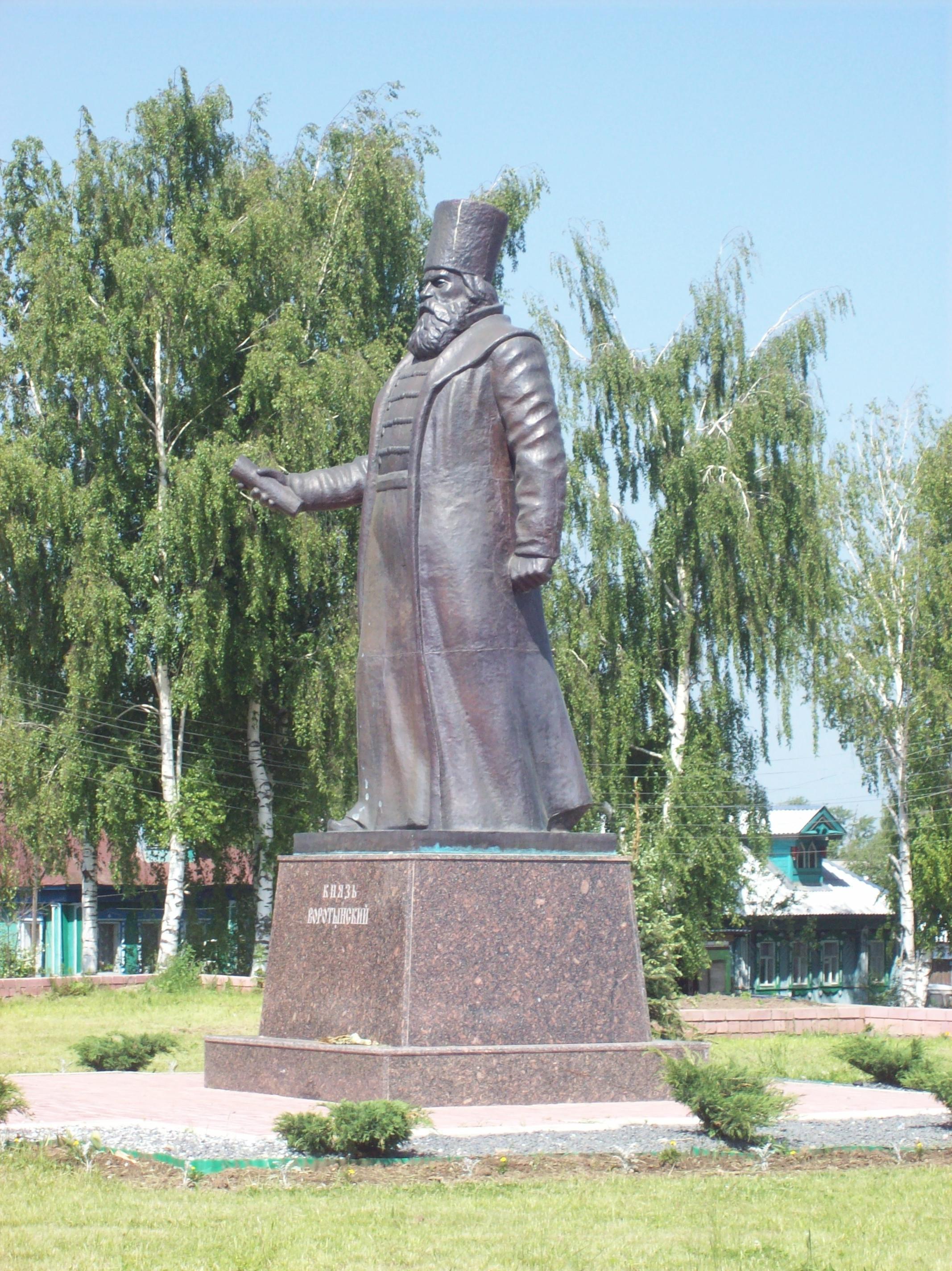
Mikhail Ivanovich Vorotynsky (1510–1573) — prince, outstanding Russian military commander of the 16th century. Author of the Charter of Border Guard and Frontier Service.
Biography
The military commander Prince Mikhail Ivanovich Vorotynsky distinguished himself with two great victories during the reign of Ivan the Terrible and was generously rewarded by the tsar. For leading the Grand Regiment in the assault and capture of Kazan in the autumn of 1552, the brave warrior received the rank of boyar and the highest title of the tsar's servant — "that name is more honorable than all boyars, and that name is granted by the sovereign for many services." This distinction was perhaps conferred upon him alone.
In addition to this extraordinary honor, the tsar granted Vorotynsky a palace volost on the Nizhny Novgorod lands near the Volga as a hereditary estate. The volost was vast — with pochinki (newly established settlements), villages and selos, ploughlands and dense forests, and also with many Mordva, Cheremis, and Russian beehive-keeping grounds where excellent honey was gathered. True, much of the land was still wild, but it was quickly being settled by incoming peasant folk, and the former discord and enmity gave way to good neighborliness.
Tracing their lineage from the princes of Chernigov, the Vorotynsky family entered Russian service from Lithuania at the end of the 15th century. Their surname derived from the flourishing ancient center of their appanage principality — the town of Vorotynsk, situated in the upper reaches of the Oka. In time it fell into decline and eventually became a selo (a larger village). Yet on the Nizhny Novgorod lands it was no coincidence that the name of the new settlement Vorotynets echoed its ancient name. This is undoubtedly connected with the arrival in the Volga Region of the capable Prince Mikhail Ivanovich. And the name Knyaginino — surely from the knyaginya (princess) — was the name of the military commander's wife, Stefanida Ivanovna.
Without question, Mikhail Ivanovich Vorotynsky knew not only his own estates but also the surrounding area well. Indeed, right before the Kazan campaign he had served as military governor in Vasilsursk, or, as it was called in olden times, Vasil. And he could not help but love the Volga River, the forested bluffs above it, and the unspoiled nature all around. Though he often had little time for beauty — the restless Cheremis, stirred up by Kazan, gave him no peace.
For a long time the tsar favored the shrewd and enterprising prince, who served honestly and loyally. But ten years after the capture of Kazan, he fell under suspicion of criminal designs and collusion with the disgraced commander Adashev. Vorotynsky was exiled to Belozersk, where he remained for three years. On returning from exile, he could no longer enjoy the full confidence of the suspicious sovereign — as many former comrades and followers of Ivan Vasilyevich could not. Disgrace and executions were becoming commonplace. Yet in moments of crisis, when the Russian land found itself in peril, persecution and grievances were set aside.
Such a terrible crisis came in 1572. A force of more than one hundred thousand Crimean Tatars, led by Devlet Giray, swept through Russian towns and villages and advanced on Moscow. Mikhail Ivanovich Vorotynsky had already erected a powerful abatis line near Serpukhov and Kolomna and had drafted the first charter of border guard and frontier service in Russia, so as to establish impeccable protection along the southern frontiers. This had become an urgent necessity, since during one earlier invasion Devlet Giray had managed to break through to Moscow itself and burn its outlying districts. This time the experienced commander set himself the task of cleverly luring the Crimeans toward his mobile wooden fortress — the gulyay-gorod — and destroying them with artillery fire. His plan succeeded completely. This was his second brilliant victory, won with twenty thousand warriors against one hundred thousand. The battle took place just 45 versts from Moscow, at Molodi.
Yet even this new great service to Russia did not save Vorotynsky from denunciation and torture by fire between two bonfires. Burned, he was once again taken off to imprisonment near Belozersk, but died along the way. The Knyaginino estate passed, at the close of the 15th century, to the son of the celebrated warrior, Ivan Mikhailovich, who was incidentally military governor in Kazan.
Service Record of M.I. Vorotynsky
Source: The Razryadnaya Kniga (Muster Book) of 1475–1598. Moscow, 1962
In the year 7051 (1543), June, disposition from the field: At Belena were Prince Mikhail and Prince Alexander Ivanovich Vorotynsky.
In the year 7052 (1544): At Kaluga, commanders by regiment: In the Grand Regiment, the Kaluga governor Prince Mikhail Ivanovich Vorotynsky.
In the year 7053 (1545): At Vasilgorod, commanders on year-long garrison duty: Prince Mikhail Ivanovich Vorotynsky.
In the year 7056 (1548), December: The march of the tsar and grand prince on Kazan business to Vladimir and Nizhny Novgorod. And from Meshchera on the right flank, commander Prince Mikhail Ivanovich Vorotynsky.
In the year 7057 (1549): At Yaroslavl there were to be commanders of the left flank: Prince Mikhail Ivanovich Vorotynsky.
In the year 7058 (1550): At Kostroma, governor Prince Mikhail Ivanovich Vorotynsky. In the year 7058, that same month of July, upon news of the Crimeans, the tsar and grand prince sent commander Prince Mikhail Ivanovich Vorotynsky from Kostroma to Kolomna.
In the year 7059 (1551): At Odoyev was Prince Mikhail Ivanovich Vorotynsky.
In the year 7060 (1552): From St. Dmitry's Day, upon news of the Nogais, at Ryazan was the sovereign's servant and commander Prince Mikhail Ivanovich Vorotynsky. And here is the decree of the tsar and grand prince, how he was to proceed on his own affairs and on state affairs to Kazan, and how to guard his matters against his enemy the Crimean tsar. In the Grand Regiment, commanders: boyar Prince Ivan Fyodorovich Mstislavsky and the sovereign's servant Prince Mikhail Ivanovich Vorotynsky.
In the year 7061 (1553), when the tsar and grand prince took the city of Kazan: And the commanders marched overland by regiment from Kazan to Nizhny Novgorod in the same month of October. In the Grand Regiment, the sovereign's servant and commander Mikhail Ivanovich Vorotynsky.
That same year 7061 (1553), June: On the 8th day, the march of the tsar and grand prince to Kolomna: In the Grand Regiment, commanders Prince Ivan Mikhailovich Shuisky, the sovereign's servant Prince Mikhail Ivanovich Vorotynsky.
In the year 7062 (1554), April: To Sviyazhsk, the tsar and grand prince dispatched as year-long garrison commander the sovereign's servant and commander Mikhail Ivanovich Vorotynsky.
In the year 7064 (1556): At Kolomna in the Grand Regiment, commander and sovereign's servant Prince Mikhail Ivanovich Vorotynsky.
At Odoyev, the sovereign's servant and commander Mikhail Ivanovich Vorotynsky.
In the year 7065 (1557), September, first day: Commanders were posted in anticipation of an autumn incursion by Crimean forces. In the Advance Regiment, commander and sovereign's servant Prince Mikhail Ivanovich Vorotynsky. That same year, household commanders: the sovereign's servant Prince Mikhail Ivanovich Vorotynsky.
In the year 7066 (1558): At Kaluga in the Grand Regiment, the sovereign's servant Prince Mikhail Ivanovich Vorotynsky.
In the year 7067 (1559), March, on the 11th day: The tsar and grand prince Ivan Vasilyevich of all Russia, together with all the boyars, decreed how to stand against his enemy the Crimean tsar Devlet Giray and how to defend his frontier lands. In the Grand Regiment, commanders Prince Ivan Dmitrievich Belsky, the sovereign's servant Prince Mikhail Ivanovich Vorotynsky.
That same year the sovereign ordered the sovereign's servant Prince Mikhail Ivanovich Vorotynsky to proceed to Kashira, and from Kashira to Dedilovo, and from Dedilovo to the field to survey locations where the sovereign and grand prince's regiments should be stationed. On August 23rd, the tsar and grand prince ordered the sovereign's servant Prince Mikhail Ivanovich Vorotynsky to proceed on service to his hereditary estate at Odoyev.
In the year 7068 (1560): At Tula, commander and sovereign's servant Prince Mikhail Ivanovich Vorotynsky.
In the year 7070 (1562), disposition of the riverbank defense from the field: At Serpukhov in the Grand Regiment, commander Prince Mikhail Ivanovich Vorotynsky.
DISGRACE
In the year 7074 (1566), September, on the 15th day: The tsar and grand prince, having deliberated with the boyars, decreed that for the defense against hostile forces at Tula there were to be boyars and commanders: Prince Mikhail Ivanovich Vorotynsky.
In the year 7075 (1567), the riverbank disposition: At Serpukhov, the right flank: boyars and commander Prince Mikhail Ivanovich Vorotynsky.
In the year 7077 (1569): At Serpukhov the boyars and commanders were by regiment: In the Advance Regiment, boyars and commanders Prince Mikhail Ivanovich Vorotynsky. And should the tsar and tsareviches begin to raid certain frontier lands, and the riverbank not be expected to face a major assault, then boyar and commander Prince Mikhail Ivanovich Vorotynsky with his comrades was to cross the river and take up positions by regiment: in the Grand Regiment, boyars and commanders Prince Mikhail Ivanovich Vorotynsky.
In the year 7078 (1570): To Serpukhov: boyar and commander Prince Mikhail Ivanovich Vorotynsky.
The tsar and grand prince ordered the senior boyars and commanders to proceed from Moscow to the riverbank: Prince Mikhail Ivanovich Vorotynsky. In the Advance Regiment, boyar and commander Prince Mikhail Ivanovich Vorotynsky.
In the year 7079 (1571): Boyar and commander Prince Mikhail Ivanovich Vorotynsky with his comrades were with the sovereign at Serpukhov. And the commanders were stationed along the riverbank by regiment. In the Advance Regiment, boyar and commander Prince Mikhail Ivanovich Vorotynsky.
In the year 7080 (1572): The march of the sovereign tsar and grand prince to Veliky Novgorod against the Swedish Germans. In the Advance Regiment, commander Prince Mikhail Ivanovich Vorotynsky. And at Moscow, to remain for the defense: Prince Yuri Tokmakov and Prince Timofey Dolgorukov.
Disposition of commanders by regiment at Kolomna: In the Grand Regiment, boyars and commanders Prince Mikhail Ivanovich Vorotynsky and Ivan Vasilyevich Sheremetev.
On the right flank: boyar and commander Prince Nikita Romanovich Odoevsky and commander Fyodor Vasilyevich Sheremetev.
In the Advance Regiment: Prince Andrei Petrovich Khovansky and okolnichy and commander Prince Dmitry Ivanovich Khvorostinin.
In the Rear Guard Regiment: commander Prince Ivan Petrovich Shuisky and okolnichy Vasily Ivanovich Umny-Kolychev.
On the left flank: commanders Prince Andrei Vasilyevich Repnin and Prince Pyotr Ivanovich Khvorostinin.
And having assembled their forces, the commanders were to be stationed along the riverbank: the Grand Regiment at Serpukhov, the right flank at Tarusa, the Advance Regiment at Kaluga, the Rear Guard Regiment at Kashira, the left flank at Lopasnya.
And that year the Crimean tsar and tsareviches came "to Serpukhov, and a battle was fought at Molodi near the Church of the Resurrection with the sovereign's commanders, and from there they withdrew."
In the year 7081 (1573): And on the riverbank, commanders by regiment: In the Grand Regiment, boyar and commander Prince Mikhail Ivanovich Vorotynsky.
The Nizhny Novgorod Estate
According to documents, Mikhail Ivanovich Vorotynsky was, from 1569, the first private owner of lands in the Zakudemsky stan of Nizhny Novgorod Uyezd.
The selos of Knyaginino and Fokino were granted to him, meaning they had already existed before that time.
Since his military service during these years was extremely demanding, it is unlikely that he was able to found any settlements here — let alone name settlements after his ancestral estate, which he hoped to recover.
Vorotynets (Vorotynesk) is first mentioned in the Cadastral Book of 1621–1623 as a selo founded by Ivan Mikhaylovich Vorotynskiy — the son of Mikhail Ivanovich.