
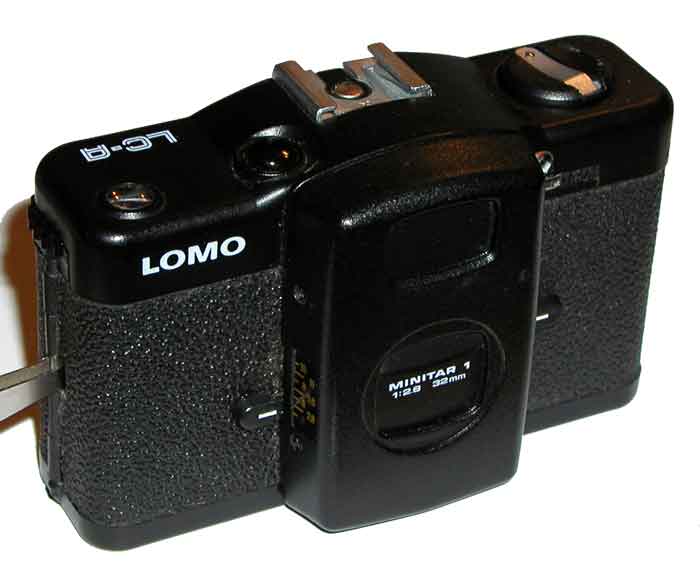
"LOMO Compact Automat" ("LK-A", "LK-M", LC-A, LCA) — a zone-focus half-frame camera with programmatic automatic exposure control.
Specifications
The "Minitar-1" lens, F2.8 / 32 mm, with zone and distance-scale focusing.
The electronically controlled shutter, driven by a resistive light sensor, handles exposures from 2 seconds to 1/500 sec., while simultaneously adjusting the lens aperture. With the automatic mode disabled, the shutter is fixed at 1/60 sec. with manual aperture setting.
Telescopic viewfinder with illuminated frame lines; light-emitting exposure-meter indicator inside the viewfinder. The body is made of rigid plastic.
As of June 2000, a total of 1,193,475 units had been produced.
The "LOMO Compact M" variant differed in the number of batteries (2 instead of 3 in the "LOMO Compact") and had slightly different dimensions: 107×68×44 mm versus 106×66×42 mm for the "LOMO Compact". The retail price of the camera in 1985 was 69 rubles without batteries and 75 rubles with batteries.
It is noteworthy that the camera served as the foundation for the "Lomography" movement (predominantly abroad).
Nature of the Phenomenon
The LOMO Compact Automat is a Soviet replica (an adapted copy) of the Cosina CX-2 camera. Its main specifications include a Cosinon 35 mm f/2.8 lens (5 elements, 5 groups), a cadmium sulfide (CdS) light meter, exposure control up to 1/500 sec., and two AA batteries. The camera was copied in the USSR under the name LOMO Compact Automat from 1984 to 1995. In Japan, a copy was also produced by Petri Camera under the name Petri PX-1.
History of the LOMO Compact Camera
(Article from the LOMO corporate newspaper "Panorama LOMO", 30 June 2003. Nikolay Vlasov, Natalya Konstantinova)
Birth of a Star
Among the numerous anniversaries that wash over our working lives in foaming waves, one more must not pass unnoticed — one no less, if not more, important than the rest. Twenty years ago, in 1983, the first LOMO Compact cameras rolled off the assembly line, destined for an unusual and long life. It is the story of how this famous camera came into being that we wish to tell in today's article.
The Visitor from Cologne
It all began in 1980, when a high-level delegation led by Igor Kornitsky, Deputy Minister of the Defense Industry, attended one of the most prominent international photo and cinema equipment exhibitions, held in the German city of Cologne. Such trips were not unusual — adopting foreign experience had been considered good form since the time of Peter the Great. On returning home, delegation members would write up their recommendations, which were then consolidated and invariably taken into account when drawing up the next production plan. The finest product samples were also purchased, serving as a reference point for developing domestic equivalents.
There in Cologne, a small Japanese automatic camera, the "Cosina CX-2", fell into the hands of the Soviet representatives. It caught the personal interest of Kornitsky, who generally paid particular attention to the Soviet camera-manufacturing industry. It is said that at this decisive moment, standing beside the Deputy Minister was Anatoly Potyomkin, head of the Special Design Bureau (SKB) for amateur photo and cinema equipment, who declared that LOMO was in principle ready to explore the possibility of creating a domestic equivalent. Kornitsky valued Potyomkin's opinion, and so the Association soon received a ministerial assignment: to replicate the specifications of the Japanese camera brought back from Cologne. The deadlines set were rather tight — only two years were allocated for developing the camera. Kornitsky personally oversaw the progress of the work.
Workaday Life
The work of creating the camera was naturally entrusted to the SKB under the leadership of A.I. Potyomkin.
The team faced a difficult challenge: to develop a device that would, on the one hand, be as close as possible to its Japanese prototype, and on the other, suit the production capabilities of LOMO. The experience of introducing the Elektra-112 camera with its electromechanical shutter into series production was still fresh in everyone's memory — that camera had proved too complex for mass manufacturing.
Within the design bureau, a creative team was assembled to work on the LOMO Compact. It was headed by lead designer Mikhail Kholomyansky. The team included lead researcher Mikhail Biyushkin, lead electrical engineer Sergey Dendobrenko, lead process engineer Ada Zaytseva, lead designer Nikolay Panteleev, lead calculation engineers Irina Sovz and Lev Sakin, and other specialists.
Staff from many SKB departments were brought in to work on the camera — the project was a priority, and people were assigned to it "as needed."
First and foremost, naturally, the Japanese camera was studied in exhaustive detail.
"Even at this stage," recalls Mikhail Kholomyansky, "it became clear that fully reproducing the Cosina would not be possible. We chose the path of creating our own, largely original design."
This applied in particular to the design of the "FZPE-10" shutter. A focal-plane shutter scheme was developed and tested on prototype samples; it ensures consistent exposure at the film frame by automatically controlling both shutter speed and lens aperture in response to changes in subject brightness and the speed of the film in use. At the time, this was a novelty. As a result, the LOMO Compact became the first domestic compact camera with a programmatic shutter. The authors of the design — M.G. Kholomyansky and M.P. Biyushkin — received an inventor's certificate for the invention. The introduction of the new shutter also yielded, among other things, a sound economic benefit.
The tight deadlines demanded a fairly high pace of work. The process was further accelerated by the practice of sending documentation on individual parts for prototype samples directly to the workshop without delay.
The Falcon's Eye
The heart of any camera is its lens. Here too, things did not come together quickly or easily. The first version of the lens, named "Minitar", was developed under the supervision of Valery Tarabukin, head of the calculation department laboratory at GOI (the State Optical Institute). After this, documentation was issued at LOMO and prototype samples were produced. But the optical workshop was dissatisfied with the result — the lens turned out to be difficult to manufacture and harbored serious problems for mass production.
Tarabukin's creation was therefore abandoned, and the development of alternative versions began. One of them was calculated by Professor Sergey Rodionov of LITMO. He is cited in many sources as the creator of the Compact's lens — which is a serious error, since his version never went into production.
However, Rodionov did have an indirect connection to the lens development: the software program he had developed for optical calculations was used in designing the optical scheme of the famous camera. At that point, they returned to the "Minitar." It needed to be reworked. This task was carried out by Lev Sakin, a member of the SKB for optical calculations, who took the original scheme as his starting point. The result was the "Minitar L," which is used in the LOMO Compact to this day.
A Ticket to Life
A key milestone in the work was the technical project review. In attendance were representatives of the S.I. Vavilov State Optical Institute (GOI), the All-Union Research Institute of Technical Aesthetics, and the Department of Trade. "The review showed that the requirements of the technical specification, personally approved by I.P. Kornitsky, had been largely met," recalls Mikhail Biyushkin. "The exceptions were only the precision of exposure control and the supply voltage. These deviations from the specification were, however, ultimately deemed justified."
In the spring of 1982, the first six prototype LOMO Compact samples were assembled and submitted for testing. They passed with flying colors, and the Interdepartmental State Commission recommended the camera for production. In 1983, the first production batch was manufactured; during that process, at Kornitsky's insistence, the camera's external appearance was modified. "The Deputy Minister wanted the camera's design to match the Japanese prototype exactly," recalls Mikhail Kholomyansky, "whereas ours differed somewhat. To be honest, I still prefer our original version to this day." Be that as it may, the LOMO Compact went into series production in the form in which it is known to the world today.
During the acceptance of the first production batch, a shortcoming was identified: the viewfinder's frame-delimiting lines were not bright enough. This was promptly corrected, and our company proceeded to large-scale series production of the Compact.
And so began the history of the famous camera that today brings joy to millions of people across the globe.
What Users Say

|
This is a compact camera (point-and-shoot size) with a good (in my opinion) 35/2.8 lens. It has no built-in flash, but it does have a hot shoe for attaching a proper flash. It is equipped with a good built-in light meter that can easily and accurately handle exposures of 10–30 seconds or more.
The light meter operates in automatic mode as follows: the aperture begins to open, and as soon as the required amount of light has come through, it closes. Accordingly, at high brightness we get a short shutter speed and an aperture of f/16; both values gradually increase, and at low brightness we get automatic shutter control at an aperture of f/2.8. There is also a manual aperture setting, which is necessary for correct use with non-automatic flashes. Exposure compensation can be achieved by setting the film speed (it accepts from 16 to 250 ISO), which is sufficient to compensate for any modern film. Focusing is done using the distance scale visible in the viewfinder, which has 4 fixed positions from 0.8 m to infinity (intermediate positions can also be set). There is also a shutter-release lock when the lens covers are closed or not fully open, and an LED shutter indicator in the viewfinder. As we can see, the LOMO Compact allows for most types of amateur photography, including shooting with exposure compensation and with proper flashes, at a quality better than the vast majority of point-and-shoots on the market (many of which have neither a light meter nor a focusing system, to say nothing of their plastic lenses and the useless built-in flash nobody asked for). |

|
.